Tuesday, April 8, 2014

INTERVIEW ON PINOYAPACHE, PART 2

ANSWERS TO QUESTIONNAIRES FROM A B.S. EDUCATION STUDENT AS A REQUIREMENT FOR STUDIES IN THE UNIVERSITY OF THE PHILIPPINES, DILLIMAN, QUEZON CITY.  SEPTEMBER 6, 2013.


1.     What professional development topics interest you?  What are your plans for professional growth?

Business!  If I could make something worthwhile about bushcraft and survival then I could concentrate more on this.     

2.     Describe the teaching techniques or strategies that are most effective for you.

Students taking notes or the teacher walking the talk.

3.     Describe a time when a lesson was not going well.  What did you do about it?

I know when a lesson is not going well when I ran out of ideas to explain certain aspects.  I let others participate instead and let them express their own knowledge and know-how and that saves me an awkward situation.

4.     How have you influenced Wil Rhys-Davies to follow your strategic vision for the organization (Camp Red)?  How did he influence you?

Bought him two bottles of beer.  Seriously, Rhys-Davies is a very intelligent dork and a well-traveled pirate.  He and Thomas Moore influenced me to shift to bushcraft and survival when they learned that the Philippines, most notably Cebu, have a dearth of people who can teach primitive-living crafts in a non-commercial manner.  Although both learned from the Aetas, they wanted to learn more skills from other parts of this country.  It was a timely meeting since I, at that time, wanted to enjoy the outdoors better instead of just climbing peaks and hiking trails.  I believed, I have outgrown my relevance to mainstream outdoor activities and needed something to shift my paradigm.  On the other hand, Rhys-Davies is trying to steal me away from Camp Red and confine all my teachings with Snakehawk Wilderness School only.  I just let myself go with the flow but I will never abandon Camp Red and I would sneak in to conduct free activities with them anytime.

5.     What was the most significant change you brought about in an organization?

Make it different from the rest.  Provide members some sort of a badge of honor; an identity that is truly their own.  Conduct consistent outdoors seminars and activities on different topics which were not taught before.

6.     Is there a specific leadership style that you’re using?  If yes, what is it?  If you’re using multiple styles, please enumerate and tell me the advantage of those for you.

I do not really have a specific template of leadership style and prefer not to know any of it or speak about it.  It is just second nature to me or my being a senior citizen has to do with it. 

7.     Describe an outstanding leader.  What makes you one?

An outstanding leader is one who would create dynamism among his community which then creates opportunities for other individuals to excel and take off from where he/she started.  I do not think that I am an outstanding leader although I believe I am some kind of leader but not outstanding.

8.     How do you define bushcraft?

Bushcraft is a definition coined by Mors Kochanski about surviving and living in the backwoods.  It is just another term to either mean survivalcraft, primitive-living techniques or wilderness skills.  As far as I know, bushcraft is survival in the wilderness on a long term; a way of life which our indigenous brothers are masters of.  

9.     What is Camp Red (aside from the information that can be found in the Internet)?  What inspired you to form Camp Red?

Camp Red is really an alternative vehicle to enjoy the outdoors using bushcraft and survival as the means.  It is a guild of artisans and craftsmen and a repository of woodlore and traditional crafts.    

10.  How did you learn your wilderness skills?

Mostly, it was from my late grandfather; the rest, from experiential education. 

11.  What are your plans for Philippine bushcraft?

When I started the Philippine Independence Bushcraft Camp in 2011, I aim to make it as an annual event.  The purpose of the PIBC is to divert people from the sickness of mass climbs done every June 12th and to teach the uninitiated about the rudiments of bushcraft and survival.  It is just confined to a certain fixed date with Cebu as the host but I am open to do it elsewhere and not necessarily replicating the event in itself just like I did to individual members of a new mountaineering federation in Luzon last October 2012.  Likewise, I also organized another bushcraft camp which is different in structure from the PIBC and will be a forerunner of an international event soon.  I want to place the Philippines in the world map as a bushcraft and survival destination.

12.  What do you see in the bushcrafters of today?

Presently, bushcraft practiced by non-indigenous Philippine population are confined only to true-blue hobbyists who are really very few in number and I consider them as precious jewels.  These few individuals may or may not be the core of Philippine bushcraft but I see this number gaining every year, thanks in part to the advent of social networking sites.  

13.  Is bushcraft a lost art or a dying art?

Neither.  It is inherent in us native peoples yet we refused to acknowledge it because we now rely so much on technology and grew on the trappings of Western-style education and methods that make it irrelevant yet Westerners wanted to learn more of it which becomes an irony in itself.  The timely setting up of the PIBC allowed that bushcraft is indeed a skill that needs to be re-learned by this present generation.

14.  How do you see bushcraft in the Philippines 10 to 15 years?  Will it prosper like mountaineering?

Bushcraft has been here for so long before mountaineering became an interest started by Europe’s nobility and landed gentry in the 19th century.  Prehistoric people had been practicing survival skills side by side with mountaineering (when it was not yet known by this term), during migration or flight.  Bushcraft will move on its own pace in the Philippines according to the sum/quality of their activities.      

15.  What do you think about LNT (Leave No Trace)?  In your opinion, where would LNT and bushcraft meet?

The spirit behind the 7 Principles of LNT is good and should be taught to anybody who wanted to enjoy the outdoors, even us bushcrafters.  Sadly, some mountaineering clubs and individuals interpret it verbatim and even make LNT as a rule instead of as a guide, which was not what was in the minds of the originators had intended it to be.  Besides that, what is applicable in temperate zones will sound hyperbolic in the tropics and quite absurd when you are on survival mode.  It is not LNT that bushcrafters have an aversion to but the very people who interpret it.

Tuesday, April 1, 2014

COMPLEAT BUSHCRAFT IX: Little Titay

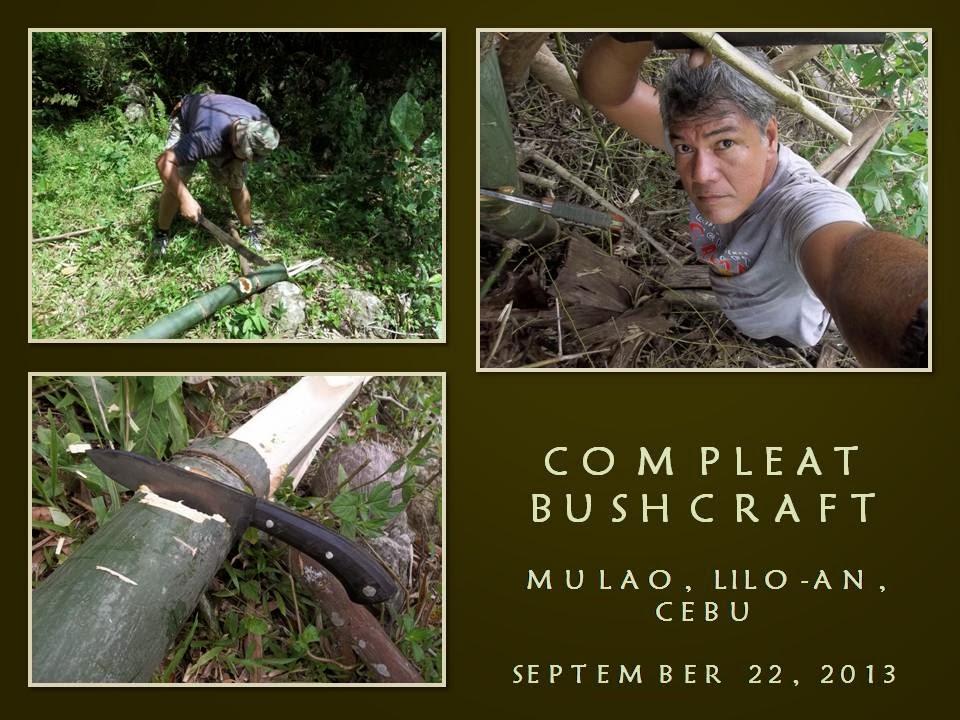
WHEN I AM NOT IN the middle, I go south.  When I am neither there, I go north.  North is where Lilo-an, Cebu is and that is where me and the rest of the Camp Red Bushcraft and Survival Guild are on the 22nd day of September 2013.  As usual, as had been our trademark, we embark on another activity that everyone in the local outdoors community now know as bushcraft.

Sadly, all activities of Camp Red are not anymore openly posted in Facebook.  We just want to keep it discrete and private and we use instead the personal message application of Facebook or the mobile phone SMS to notify people.  We had already decided that bushcraft and survival skills are not for everyone.  It is just for the deserving few. 

We are not trying to be an exclusive club, if you do not mind.  We just want to ensure that what few members we have are complying with the philosophy of Camp Red.  We want a guarantee that all had undergone a radical shift of their paradigm when it comes to enjoying the outdoors.  We want to be sure that your heart is with Camp Red and so are physically present to support its activities.

It pains me to adapt to this style to the exclusion of the rest.  But it is best that we conform and maintain the good quality of our activities by inviting the right people, give and take a few novices.  I see a lot of lurkers, wallflowers, dormant accounts, the no-shows and the trolls in Camp Red’s FB group account and cleaning it won’t solve the problem.  A lot of people still want to “join” that site.  I understand, it gratifies people just to be around so I let them be.


Anyway, I just contacted as few people as possible.  Jhurds Neo, Dominikus Sepe, Nyor Pino, Bogs Belga, Justine Ianne and Faith Tannen came to the meeting place early morning at Mandaue City and we all commute to Lilo-an.  Already at the second rendezvous point are Glenn PestaƱo and Christopher Maru.  Last to come is Aljew Frasco with his 4-year old daughter, Titay (pronounced as Tee-tie).

You know what, even though bushcraft and survival is a serious outdoors activity, I would love to involve family members.  I believe you have an obligation to pass on your knowledge of woodlore to your immediate family, which my late grandfather did to me when I was a tot.  I want this to happen with Camp Red and Aljew’s move is the best example.

Aljew drove the Toyota Lite Ace to the village of Mulao.  This is the second time we do a bushcraft jaunt there.  The camp is on a bank of the Cotcot River underneath an old acacia tree.  A spiny bamboo grove nearby provide us the material for our primitive tools, our cooking, our firewood and to test our knives.  We are passionate of our blades and proud of what we own that we carry it openly while among the woodlands.

The river have subsided a few centimeters yet it is still a swirling mass of liquid racing to the shoreline and the Camotes Sea.  The water is good enough for washing and cooking but you have to boil or filter this for drinking.  The wide pool infront of the camp is perfect for bathing.  Amidst all these, catfish and other river creatures prowl and forage.


Aljew returned to me his prototype AJF Gahum heavy-duty knife after a few adjustments by him.  To recall, the AJF Gahum is his first design and he commissioned me to do the honors of testing it under adverse methods and conditions.  Although its tempering is, without a doubt, superb, the original edge angle left a lot to be desired.  Today, I will again test it under the eyes of its maker.

Aside from the AJF Gahum, I (absently) carry a lot of blades, which I could not believe, since this is just a day activity.  I have my long-time companion of the woods – the tomahawk, a William Rodgers bushcraft knife, a Victorinox SAK Trailmaster, a Leatherman Tool, a Puffin Magnum spin-off, a Buck 112 folder and a Seseblade Sinalung knife.  Yes, too many and too redundant in functions but they are my brothers and they are essential weight.

The spiny bamboo is protected by a screen of thorns and the only way to get a pole is either you have to slash a corridor among the thorns or prop a couple of wooden poles over it like a bridge.  I use the latter method since the screens are quite formidable.  I could not produce wood but there are old bamboo poles around and I place it over where the screen of thorns is not that thick.

The old bamboos creak underneath my feet as I slowly traverse this makeshift span from ground to the poles.  When I have reached a pole, I raise the AJF Gahum to bear on the bamboo, the decaying bamboo poles which I stood upon shudder and make cracking noises.  It is not easy.  If that platform breaks, I would surely get snagged on those thorns.  I hold on for dear life on a branch until I am able to bring down a pole.


Surprisingly, I find the AJF Gahum so different now from the last time I use it.  It could bite fast and it does not deflect in its course of penetration, like light on a glass of water.  Aljew did a good job of grinding it at a good angle.  The knife is now technically sound and I will test it later on dry bamboo and on a base of a mature coconut leaf.  I remove the leafed branches from the pole effortlessly.

After I have chosen the best part, the rest of the dismembered pole, especially at its thickest part which is the bottom, becomes the property of Camp Red. Every blade is tested on it from a 32-inch pinute1 to a 3-inch ESEE knife. I also tested a Seseblade NCO Knife, on request, and it is recorded on video which, hopefully, would make Dr. Arvin Sese happy.

I use the short pole that I have separated from the rest as cooking pot.  There was already a robust fire started by the rest near the acacia tree and I place the pole over it to cook rice.  Elsewhere along the riverbank, hot coffee is being served by Christopher while Jhurds is perfecting his simple shelter then shows everybody what is inside his first aid kit.


Bogs practices fire-making on a bow drill after trying out an imitation tracker knife.  Meanwhile, another set of fire is teased to life by Aljew while little Titay gets a bow lesson from Faith.  Glenn talks about his knives and how he gets it as Nyor and Justine listened intently.  Every bushcraft excursion is a productive day as each individual gets to learn new skills freely given and exchanging ideas and gears are just as casual.

Three locals catching fishes along the river supplement our meal with four fresh catfish after we had paid for it.  We grill it over a fire along with pork and chicken.  Aside that, Dom cook spicy chicken soup.  When all the cooking was over, the food are splayed on two big banana leaves ala “boodle-fight” fashion.  It is almost 2:00 PM.

After the meal, Aljew carried Titay to the stream and both immersed in its cool water.  It is perfect bonding time for father and daughter and it is best that they be left alone.  We proceed on to the testing of our blades.  The AJF Gahum is able to slice a very dry and slender bamboo hanging as a branch with a quick stroke which other blades failed to accomplish.  The AJF Gahum also penetrated the hard base of a mature coconut palm leaf which caused other blades to bounce off. 

When we felt that the afternoon is throwing long shadows, we begin to pack up our things and hike back to the village center of Mulao where the Toyota Lite Ace is parked.  We go back to the main road but we take another route to assess another place which Aljew thought of as another possible venue for a bushcraft jaunt.  When we are done with that, we go back to the road and into the highway.


The Lite Ace entered an iron-wrought gate and into a garden where there is a coffee table and chairs.  We all transferred to the chairs and continue on with the conversations and jokes.  It is a noisy company.  Aljew brought out his two boxes of knife collection.  Everyone becomes mute and, as if in cue, all hands reach out into the boxes and feel the texture of each blade.  It is slightly interrupted by dinner and returned, once more with intensity, when cold beer where added to the fuel.

As for myself, I get to hold and caress an obsidian knife which is separate from the boxes.  It is strangely familiar in my hand as if my subconscious had shuttled me backwards in time.  The whole knife, particularly the edge, are worked in perfect detail in imitation of those done by aborigine inhabitants of pre-Columbian America when metal was not prevalent.  My veneer of conviviality hid whatever spiritual re-awakening I had felt when I held it.       

Another item which Aljew had held so dear is a Philippine barong2 that is paired with an elk antler handle wrapped with braided leather. It is a fusion of east and west. A work of art. The blade danced as I imitate the swings, the waves and the turns of a stick fighter’s hand. It moves so smoothly well whenever I bring it to as if hand and blade are one. I had unintentionally created a bond with this strange barong when I slightly sliced one finger tip.


My interactions with the different blades had been tempered down by two shots of a Laphroaig 10 Years Old Scotch Whiskey which Aljew generously shared to the jovial group.  It is smokey and peaty.  Unbelievably smooth.  I have come to taste the finest scotch.  It leaves an aroma associated with fresh wet moss that goes with me when I got home and the morning after.


Document done in LibreOffice 3.3 Writer


1A single-edged blade, usually from 24 to 32 inches in length, which is prevalent in Central Philippines.
2A native blade popular with the Tausug and Yakan warriors of Southern Philippines. It is single-edged but is between 10 to 16 inches in length.