REALITY
PROGRAMS MADE for cable TV are very interesting and educational and
command such attention by viewers all around the globe, especially
concerning primitive-living skills and survival. Bear Grylls is the
name that usually crop up when my mountaineer-friends talk among
themselves ever since I begin to attend again membership meetings
with my old club after a long hiatus of eleven years.
That
was in 2007 and, unfortunately, I do not have a cable TV connection.
Even today. Anyways, the things that Grylls did, which I overheard
from my friends, were quite familiar to me and I could do that as
well with much finesse and sanity but, being a mountain climber then, I
was wrench-locked to follow the principles of this foreign ideology
called Leave No Trace.
As
I slowly veer away from LNT, from insane mass climbs and from my
former club, I begin to practice free-rein outdoorscraft like
survival and wilderness skills. A recent Cebu visitor, Thomas
“Tomahawk” Moore, have greatly influenced me on this when we met
in September 2009. The joys of having a small campfire is a freedom
that I love to cherish most as well as my freedom of unimpeded
movement like solo hikes and cutting across virgin ground.

In
January 2010, I established a club called Camp Red Bushcraft and
Survival Guild. This is the only one of its kind in the country and
I organized the annual Philippine Independence Bushcraft Camp every
June 12th as its main activity. Not only that, I begin to make
videos of myself doing things I loved best and uploaded these to the
Warrior Pilgrimage Channel in YouTube.
As
the pleasures of my new-found interest guided me, names of other TV
survivalists like Les Stroud, Ray Mears, Mykel Hawke, Cody Lundin,
etc. begin to surface up. To be honest, I have never watched a
single show of these survival shows and it was only in August 2012
when I finally saw what Grylls looked like and what he did in his
show when a video was uploaded at Camp Red’s Facebook site by one
of the members and it was about le Legion Etrangere.
When
I teamed up with William Rhys-Davies in January 2013 to put up
Snakehawk Wilderness Skills School, a small production outfit wanted
to do a series of video shoots about tropical bushcraft and survival
in the Philippines. The location of the first episode would be in
Guintarcan Island, Santa Fe, Cebu and it would star, no less, by
Rhys-Davies and myself. For this project, I was provided two videos
of Ray Mears for study. It was the one shot at Costa Rica and
another at Palawan.

On
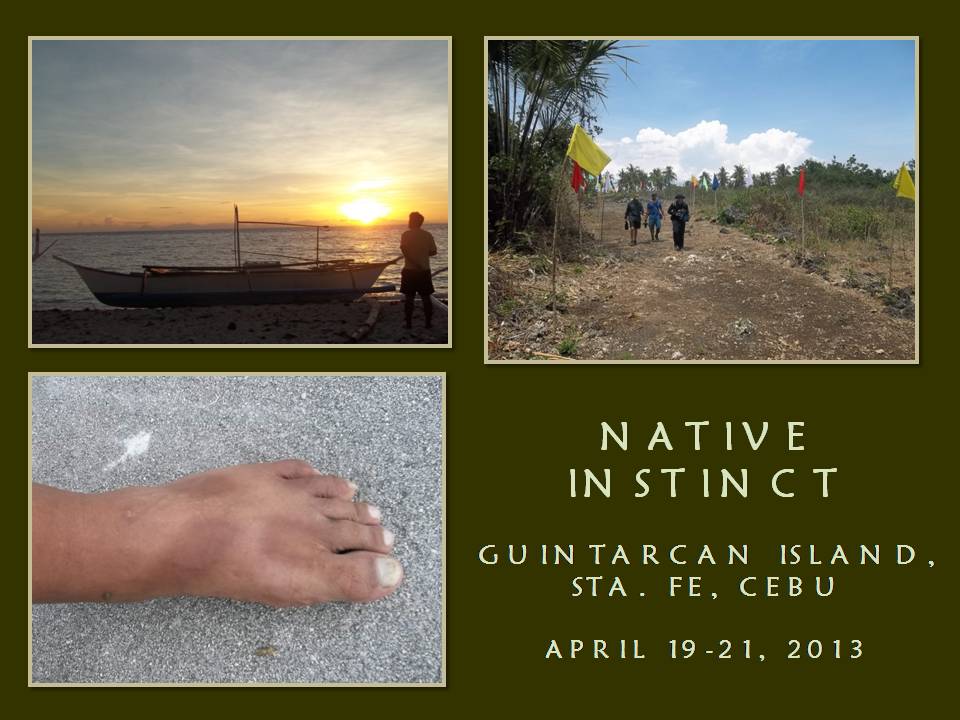
April 19, 2013, we left the mainland and cross the Bantayan Channel
for Guintarcan. Our host is Mrs. Tita Rosos, who accommodated us all
into her residence which became our base camp. The video crew
consist of the producer/director/cameraman – Matt Everett;
cameraman – Prem Ananda; two personal assistants; and a medic –
Casey Ballard. Aside that, we hired Tady Rosos as our man Friday and
the boat owned by Inday Dabalos
The
videocam begin its shoot as the outriggered boat begins to set sail
for the island. The weather is perfect giving us a very calm sea
although the heat and humidity are at a high swing and would later
take a toll on the exposed skins of the cameramen, the medic,
Rhys-Davies and, mildly, on myself. The show, according to the
producer would almost follow along the lines of Dual Survival
of Cody Lundin and Joseph Teti but with a different twist. Guess
what that would be? But, who are these guys?
The
first segment for the first day is catching us swimming from boat to
shore about 100 meters distant in our clothes. I am wearing a
light-blue rayon T-shirt, a dark-blue Rohan long pants and a
pair of beachcomber shoes. Rhys-Davies is in his Lowe shirt,
a Silangan hike shorts and a pair of Salomon shoes.
There were a lot of shots from different angles above the surface and
underwater; two-way dialogues; and one-on-one talks to the camera.
Talking
before a camera is nothing new to me especially if it is a self-shoot
or done in jest with another. But with a professional-looking camera
with a professional behind it, my self-confidence begins to waver.
Feelings that I knew of during job interviews done long ago, suddenly
came back at light speed. My eyes kept rolling to retrieve missing
words, stopping me in mid-sentence, and, possibly, would make me look
like a clown before a wide audience if not for retakes.
In
the afternoon, the director need to do many retakes of our swimming
prowess. We shifted scene afterwards and asked to make a debris
shelter. While doing that, there are the usual dialogues between
Rhys-Davies and me and then the one-on-one on camera. I was asked to
forage for food, which I did, by plucking a ripe fruit of a pandanus
tree. We ate the fruit explaining to the invisible audience of its
taste and how it is eaten.

I
split and cleaned both green and mature coconut palms with a William
Rodgers bushcraft knife. The dry palm is hard but the blade
make short work of this. While I was in the middle of driving the
edge hard in the middle of the palm, the knife point nicked one of my
fingers and blood spurted out. I have already expected getting cut
by my new knife and it created a bond between new
owner and blade. I remedy the discomfort by making a poultice out of
Indian mulberry leaf buds after stopping the bleeding by elevation
and direct pressure.
The
knife had been given to me by the CEO of a native delicacy company
just recently in appreciation of my outdoors prowess and for
friendship’s sake. He is not just a knife collector but work on
his knives to their ultimate limits. The knife comes with a leather
sheath with Kydex lining which he himself made and dyed; quite rare
for a business executive.
I
was really exhausted after doing several repeats of sequences of
holding breathe under water for almost the whole day, swinging from
coconut palms in the hope of detaching it from the upper trunk and
trying to polish off my pidgin English that I collapsed onto my
ground tarp splayed on hot concrete after supper unmindful of the
heat it refused to surrender. I slept like a baby under the bare
sky.
After
breakfast of the second day (April 20), we went back to our shelter
and, part of the script, I would again forage for water and food
which I found up a coconut tree which need to be climbed. I ascended
below the crown and twisted two fruits with my hand and let it fall,
cut a hole and drank its sweet water, and split it open to scrape the
white meat. All these are but natural for me while Rhys-Davies made
himself helpful by teasing a fire to life with his firesteel.


In
the afternoon, we walked up a hill to shoot a scene inside and
outside of Cantingting Cave to look for food. After some dialogues
and talking to an invisible audience, I foraged old coconut palms and
fashion these into three flame torches which we will need to light
our way inside the cave and, hopefully, catch our prey. The script
goes that we need to catch bats to sustain our survival.
The
light from the flame torches are inadequate and make it impossible to
catch bats so I place the torches upside down so it would bellow
thick smoke and agitate the bats from its stupor high up on the
ceiling and waited for them to swarm out of the cave. I position
myself outside the cave mouth with a three-foot stick like Barry
Bonds while Rhys-Davies stayed inside to shout and scare the bats.
The bats did start to fly into my position and I whack five of these
senseless. We now have solid food for the day!
It
is dusk when we returned to the beach where our shelter lay. The
camera focused on my skinning of the bat and I explained to the
absent audience why I need to remove a certain part of the animal so
it won’t spoil the meat. On the other hand, Rhys-Davies tried his
darndest best to ignite a fire with partly-moist coconut fibers which
he used as tinder. After a considerable amount of sweat running down
on his brows, the flame flickered and danced.
Rhys-Davies
sharpened the points of two bamboo sticks and I pierced all the
dressed bats unto it and cook it on open coals. I talked to the
camera how I reacted when Rhys-Davies failed to produce fire and
talked also of my plans for the rest of the day and of the following
day. We leave the set and returned to base camp. There was a slight
shower after dinner and everyone heaved a sigh of good relief that
the extreme heat of the day will soon dissipate!
The
third day – April 21 – found us swimming by the shore and
skimming for food on its part-sandy part-rocky bottom. This island
is abundant of shellfish of different varieties and, it is only a
matter of time before we will fish it out of the sea ourselves.
There were many sequences taken by underwater cameras and too few
moments to recover our breathe. It was a never-ending battle to stay
under despite the onset of tidal current.
To
counter buoyancy, I held on to rocks and, in the process, detaching
these. Beneath some of these rocks are juvenile giant clams (sp.
Gigas Pacifica). Elated with these discovery, I plucked out four
clams while Rhys-Davies was successful with one. Using my knife, I
forced it all open and removed the flesh from the shells and skewer
it with last night’s barbeque sticks and cooked it again on bare
coals which Rhys-Davies expertly provided.
When
we have finished lunch, the rest of the afternoon is dedicated to
foraging bamboo poles, which are abundant on the island, so we could
make and float a raft and make a run for the mainland. We found a
grove of spiny bamboos. The problem with this kind of bamboo is that
the base is protected by a screen of thorns. I explained to the
camera how I would extract the poles using a bolo and a knife.
I
created a corridor by slowly removing the lower branches where there
are spines. When these tangle with each other, these create a screen
and always snag on anything soft like fabrics and human skin. I got
snagged on the base of my thumb and blood begin to ooze as I started
to cut and remove these. Altogether, I cut three poles which is
about twenty feet each and drag it each time it is caught on the
branches of a mango tree.
Slowly,
one by one, to and fro three times, we shoulder the bamboo poles from
the interior to the shore. I measure the pole by their segments and
cut it with the bolo. The knife cleared and cut the knobs and
branches. We were able to make six eight-foot long poles as our main
deck. We have also provided four poles as our cross bars eight feet
long. On the beach are four abandoned 5-gallon plastic containers
with caps and a considerable length of nylon rope which a fisherman
abandoned.
Rhys-Davies
did the lashings as he is well-adept at this while I assisted him in
feeding the ropes or reaching a rope end at the most difficult
corners with a finger. The containers were distributed along the
four corners of the bamboo raft and would be the main buoyant
component while the cross bars would hold it like a vise. I provided
two coconut palms, stripped of leaves and carved, as our paddles. We
tested the raft’s sea-worthiness and it floated well with me and
Rhys-Davies on board.
The
last scene would be rowing from shore to other shore thirty
kilometers or so away crossing the Bantayan Channel. Could this be
possible? Are we in our right minds? Perhaps or perhaps not. But
with perfect weather, with a sail and lots of fortitude and luck, why
not? We could even make it by morning. This was the crux of the
show but the director intervened by towing us back to shore with a
motor boat and Rhys-Davies capped it off by promising his imaginary
audience that we would be back for the next episode.
Document
done in LibreOffice 3.3 Writer