Monday, September 22, 2014
BUSHCRAFT IN THE PHILIPPINE OUTDOORS SCENE
SINCE
THE TIME I shifted to Bushcraft and Survival, I now know where I am
going. This is no accident for me but it had been motivated by one
popular TV show whose producers made one fine dude into a buffoon.
That show had made nonsense of what bushcraft is really all about. I
know that, for I had been taught primitive-living skills by my late
grandfather, who exposed me to woodlore at a young age.
In
the Philippines, bushcraft or primitive-living skills or wilderness
survival or off-the-grid living is still practiced by a good
percentage of the populace, even more so, when you travel to the far
countrysides. Shades of it are even carried by migrants into the big
cities but that is just all about it. Nobody is interested anymore
because it is low technology and inconsequential. This present
generation thinks that the search engines and their tablets could
provide them of what they want.
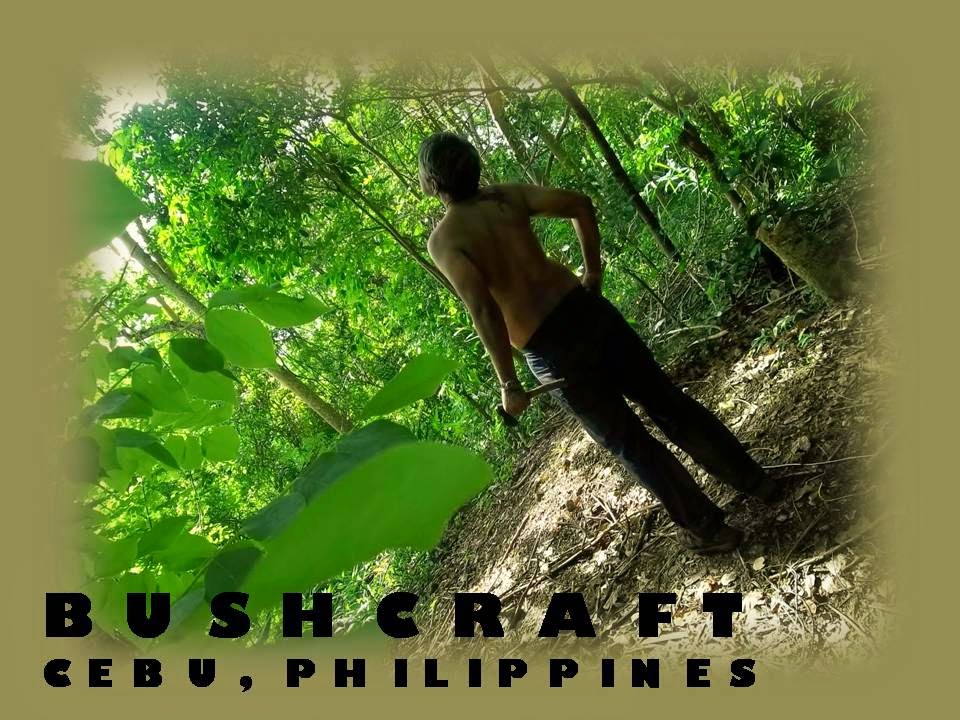
This
direction I am talking about is imparting my knowledge to people and,
at the same time, converting contemporary yuppies into weekend
bushmen. My philosophy of enjoying the outdoors is not conventional
and does not follow how the mainstream work but I place it in a
proper perspective so it could be understood better by those who may
practice it. It is an activity that uses a lot of common sense and a
good dose of hard labor, although it is disdained by many
conventional types because of its nonconformist methods.
I
would like to emphasize that there is more of the outdoors than just
being conventional or mainstream. I have seen the difference because
I had been there. I cannot comprehend long ago why my hands were
tied when I am supposed to enjoy “ultimate freedom”? It is not a
very good idea going on camping with someone watching behind your
back constricting your movements along the rigid lines of a foreign
ideology called Leave No Trace.
Be
advised also that there is a limit to enjoying a bushcraft activity
which is really different from what you see on TV. You do not just
cut green branches without considering the type of species. You do
not just make fire without a purpose and without also considering the
impact it gives to the camp ground. You do not just show off your
blades on popular mountain sites without offending the sensibilities
of certain people. Our own concept of the outdoors does not
necessarily gets appreciated by the mainstream crowd.
People
are now more aware of their environment because they choose to help
and preserve Mother Earth in a good state in whatever way they can
and that is good. Their adherence to LNT made them better hikers or
mountain climbers, I suppose, and educates other people who visit the
mountains for recreation. Ethical backpackers are incensed of people
and activities that despoil the environment and are now more forceful
in their approach. Rightly so, for a lot of reasons like garbage to
fire rings to mass climbs to crowded campsites to commercialism.
I
am practicing Philippine-style bushcraft and I make it sure that its
impact on the environment is negligible if you compare it with how
Westerners does theirs. I shun popular campsites and I would rather
be with as few people as possible so we could enjoy bushcraft better.
I encourage my adherents to practice light backpacking and to absorb
the principles of “adapt, blend and improvise”. Campfires are
mandatory on preparation of meals but, do not worry, we keep it
small.
Conventional
hikers always love to camp on high places and when they see fire
rings on their beloved campsites, they would attribute that to
bushcrafters even though it runs contrary to how and where we choose
our fireplaces. We prefer hidden nooks, inconspicuous places that
are too remote and wild, even to an adventurous urbanite but,
sometimes, we use our old haunts which are now frequented by people.
We equate our activities akin to those of indigenous people and we
imitate their ways of moving about in a forest.
We
learn plant ID by heart and that distinguishes us from firewood and
charcoal gatherers who cut trees wholesale. We prefer cutting green
limbs from introduced or invasive species, if we do not find any left
behind by locals, when we need it for general bushcraft work.
Firewood and kindling we get from dead branches which do not touch
the ground and save someone the trouble of being hit by a falling
one. We forage and use wild edible plants on our cooking; natural
fibers for cordage; and natural tinder for our fire kit.
What
we cannot leave behind, we burn. Any organic refuse, goes back to
the land. As much as possible, only opened cans and empty bottles
goes back to civilization to be sold in junk shops. Bringing in of
garbage back to the cities are unnecessary since it would only use
more fuel needed to transport these to dump sites, add more man hours
and help hasten the filling up of landfill projects. Smoke from
small garbage we burned in an hour of a weekend are peanuts compared to everyday
poison unleashed by coal-fired power plants and vehicle fumes.
The
importance of knives in bushcraft and survival are supreme and its
presence in all our activities are mandatory. If you cannot stomach
the sight of it, then keep your distance else learn from us. We have
no other purpose for the knife except as a tool and, without that,
tasks would be downright difficult to accomplish. Nowhere else is an
outdoors hobby would you get to learn a myriad of skills except here
in bushcraft and, as always, the knife is very relevant.
Where
does one learn bushcraft here? If you search the Internet, this word
is confined to countries that are mostly found on the temperate
zones. In the Philippines, your search will take you to Cebu, the
Philippine Independence Bushcraft Camp and me. Yes, I teach
bushcraft only during the PIBC, which is always held on June 10 to
12. The Mountain Climbers Alliance of the Philippines also requests
me to teach their members wilderness survival each year. Apart from
that, I instruct people indoors about urban survival techniques.
To
keep and maintain the skills of local bushcrafters sharp all the
time, I established an organization for this purpose: the Camp Red
Bushcraft and Survival Guild. It is the only one of its kind in the
Philippines and is based in Cebu. Camp Red members are always out
there on the field every weekend, hiking mountain trails, exploring,
foraging, learning outdoors culinary, firecraft and a lot of
real-world skills. You can distinguish them by their preference to
carry openly their knives.
Bushcraft,
for me, is the ultimate experience. You are the sole master of your
own fate and you will know the mountains and its valleys and rivers
more than anyone else. You just stay in a few places while everyone
else are preoccupied of their time and destinations, totally missing
out the finer details of a journey which would have given one lasting
impressions, wonderful discoveries and irreplaceable wisdom. I have
achieved total and unimpeded freedom doing all these and no foreign
ideology, modern technology or expensive gears had altered or
prevented that.
Bushcraft
shall remain outside of the mainstream and so would the men and women
who had embraced it. It will never ever replicate activities of
conventional outdoor interests nor would it intrude on their realm
but it can be integrated into theirs, with a few adjustments to their
individual’s mindsets. I have come to the conclusion that
Philippine-style bushcraft will stay for good and it will develop
people into self-reliant individuals who may become leaders of a
community of survivors should there be a SHTF situation.
The
introduction of bushcraft as one of the activities in the Philippine
outdoors scene should be welcomed, even from those whom have thought
that the outdoors is their monopoly. Although we do not abide by the
principles of LNT, we understood the spirit by what it was meant for
and we have our own set of values when in the outdoors. We
appreciate nature very much and we, like the rest, are never in a
good mood when our mountains are abused. It is our playground as
much you had considered it as your own.
Document
done in LibreOffice 3.3 Writer
Posted by
PinoyApache
at
09:00
2
comments
Labels: bushcraft, Cebu, commentary, Philippines
Tuesday, September 16, 2014
NAPO TO BABAG TALES LXXIII: Pyromaniacs
THE BOAT FROM CAGAYAN de Oro
arrived at 06:00 today, February 2, 2014.
I know that the Camp Red Bushcraft and Survival Guild are congregating right
now at Guadalupe for another outdoors sortie at the Babag Mountain Range. I have to be there in the fastest time
possible as this is an important activity which would not go well with my wife. She kept complaining that I have no more time
in the house except to eat dinner, watch TV, sleep and drink coffee in the
morning.
Well, deep inside, she knows
that men of my age are prone to heart diseases caused by inactive physical
exertions and unhealthy lifestyles. I
know she would agree with my continued absence during weekends as long as I do
not go home drunk and cut in noisy. In a
blur, I am out and running to the street carrying the same bag that I used
during that travel to northern Mindanao.
I commute twice from home to
Jones Avenue to Guadalupe and I notice people with candles on the streets and
inside public jitneys. Of course, it
reminded me that today is the Feast of Candles and it marks the end of the
Advent of Christmas. It is the birth
anniversary too of my late maternal grandmother, Purificacion, and my late
paternal grandmother, Presentacion. I
arrive at the parking lot of the Our Lady of Guadalupe at 08:30 and I feel that
the Camp Red guys are now hitting the trail from Napo to Lower Kahugan Spring.
After eating two moon cakes at
a bakery, I hurriedly take a motorcycle ride for Napo. At around 8:50, I am now hitting the trail
myself. I notice the Sapangdaku Creek
very robust and noisy, the result of a typhoon that had passed by a day ago
which dumped a great volume of rainwater.
I open carry a Seseblades JEST Bolo for today to test it. I follow the trail and begin counting the
footprints. Each individual are
distinguishable by a different shoe tread but there are just too many, overlapping
each other and I have to try.
I was at this act of studying
the tracks when Dominic Sepe arrive near a mango tree and we both help each
other distinguish the shoe prints. Here
is a Vibram sole and there a running shoe. No, two people with running shoes! Quite small, maybe a woman’s, but the imprint
is deep, it could be a man’s. There are
a lot of hiking shoe prints, very wide and with deep furrows. Some smudges, made by locals wearing rubber
slippers. I do not think that all these
shoeprints are made by Camp Red people.
Surely, there are other groups of hikers today.
We reach Lower Kahugan Spring
and I top off my water bottle. The
stream is flowing freely and it is full.
Gone are the debris and the big stones used as a footpath and replaced
by another set of stones, smaller and unstable, that looked like a tiny
dam. I surmise that our guys would take
the long Kahugan Trail and so, I decide, we take a shortcut to our destination
which is at the Roble homestead. I
follow this route and I see fresh footprints and no Camp Red bushmen would surely
walk this very steep path.
When we arrive at our meeting
area, the group of Barry Paracuelles and Maria Mahinay are already there. Two ladies and another guy are with them and
I notice Barry and the other guy wearing running shoes and that answers the
shoeprints I studied a while ago. So the
Vibram sole must have belonged to Aljew Frasco as what Dominic had
suggested. When the Camp Red group do
arrive, Dominic had guessed correctly about Aljew’s shoes, eliciting a smile
from him.
I see Jhurds Neo, Christopher
Maru, Fulbert Navarro and his girlfriend and the new guys, Jerome Tibon and
Tope Laugo. It is nice to see them again
and I believed Jhurds had planned a firecraft activity for today. I have brought my fire kit, which consists of
safety matches, a butane lighter, a ferro rod, fatwood, charclothe and a
jumbled mixture of foraged tinder. I
also brought pieces of pyrite which I found in that trip to Mindanao to test it
if it could give a good spark if clashed with steel.
By now, the guys are foraging
firewood and sticks to make tripods.
Black-soothed cooking pots are familiar fixtures of bushcrafters unlike
those of the spotless ones that conventional outdoorsmen carry. We at Camp Red prefer to cook our food with
fire coming from wood instead of canned fuel.
The more we use firewood, the better our skills with making a fire and
it does not matter if we use a matchstick or with friction to start it, just as
long as it is done the bushman’s way.
I make the JEST bolo work on
the cutting and splitting of wood. I use
a baton on the stoutest wood. I found
the JEST bolo easy to use as long as it stay sharp. This bolo had been given to me by Dr. Arvin
Sese, through Jay Z Jorge, while I was conducting a Basic Wilderness Survival
Course in Antipolo, Rizal last October 2013.
It comes with an Igorot-inspired wooden sheath and a webbing belt with
clip lock. I even use it with the
pyrites and minute sparks appear.
When the group of Barry and
Maria had left, another group of five hikers came. It seems, they are part of the first group
but this habit of failing to come on time wrecked havoc on someone’s
itinerary. It is not our concern though
and it has no effect on our activity.
The fires had now started and the rice is now ready for cooking which
Fulbert is now focusing on. Dominic
produce iron grilles and lay it above the surging fire, a prelude to a
delicious barbeque.
The pots used for rice are
suspended on two tripods from which separate fires blazed below it. The pyrites were tested on the steels and
anyone could choose to keep the pyrites for himself. I also brought an industrial bearing cap
which composition approximate those of a micarta. It could be sawed into small pieces and filed
to proportion as knife scales. I gave
this to Jhurds for his unending knife projects and, hopefully, this piece would
provide him satisfaction.
Anyway, a mixed-vegetable soup
with oyster sauce is now on its final stage of cooking while the steamed fern
tops are now transferred from pot to plate.
The thin strips of pork and beef are giving off smoke and pleasant smell
and the gastric juices are beginning to play on our tongues. It is 12:00 and everyone gets a seat inside
the visitors shed as the prayer before a meal is lead by Fulbert. Refills after refills, the food gets
decimated by the hungry band of bushmen without a whimper.
When we had recovered from that
feast, Aljew produced pulp wood and begin carving a spindle and a fireboard;
familiar items for a bowdrill. On the
other hand, I go downhill and look for a dry pole of bamboo which I found and
cut it to size with the JEST bolo. I
carry it up and keep it near a fire to heat it and then refine it as a
fire-making implement. While Aljew is
showing to all how to make a bowdrill set, I show to Jerome and Tope how to
make a bamboo-saw set.
The knife, together with the
folding saw of either a multi-tool set or a Swiss Army knife, are very
essential tools since, without these, it will make this work difficult to
perform. Aside that, you need a lot of
patience to make a fire by friction. It
is not done in conventional fashion but through stages. You have to follow the process slowly and
forcefully to achieve an ember. Presence
of smoke is not enough though but persistence will.
Aljew produced a fire with the
bowdrill. The bamboo saw did not
although the presence of smoke is one step less to achieve an ember. Jerome tried to improvise but with no result
breaking the bamboo in two. Christopher,
on the other hand, produce fire with the same bowdrill. Tope took the reins of the bamboo assisted by
Fulbert and produce smoke yet the magic ember is missing. Jhurds, after failing a first and second
attempt, achieved success the third time on a bowdrill. Persistence after patience.
Fele Roble, a farmer who just
observed what everyone did, made a fire using the bowdrill. It goes to show that the techniques in the
bowdrill are easy to do compared with the other methods and that is why when I
conduct the yearly Philippine Independence Bushcraft Camp, I make it sure that
the bowdrill is given a demonstration on the same level as that of our hometown
favorite, the bamboo saw. On the whole,
I find preference with the bowdrill as it does not use energy that much.
On the other side of these
pyromaniacs, the steel and flint, although more crude than the modern ferro
rod, could give off sparks as efficiently as those rods provided you use a
charclothe. The ferro rods, available
commercially now through the advent of survival TV shows, produce a lot of
sparks that could ignite even a sawdust from a half-dry wood. It is now the standard equipment for all
outdoorsmen, replacing the safety matches and the lighter, since it could be
used more than a thousand times, even in wet or cold days, and is much safer.
The tinder could be sourced
anywhere or you could make it yourself like the charclothe. Foraging tinder is the best practice. You collect and collect until you think you
have enough. Any combination of natural
and manufactured tinder is good and would save you from a bad day in the
woods. For insurance, carry rubber
strips and thick plastic. These are good
material to kindle a fire under extreme circumstances. It will never fail!
When it is 16:30, we start to
leave the Roble homestead together with a couple of hikers, who had enjoyed our
fire session and the powdered corn coffee.
We go by way of the route I took in the morning. It is not that slippery as the ground is
moist. We reach the stream and walk the
trail back to Napo and to the parked red pickup owned by Aljew. We take a dinner at AA Barbecue Grill,
complements of Aljew, and capped the day’s activity with a few rounds of cold San
Miguel Pale Pilsen.
To appease my wife, I gave her
my Seseblades JEST Bolo. She knows how
to use a blade, she being bred from a prominent homesteading family who
pioneered a community in the wilderness of Mindanao. It all goes well.
Document done in LibreOffice
3.3 Writer
Posted by
PinoyApache
at
10:00
0
comments
Labels: Camp Red, Cebu City, firecraft, survivalcraft, tool making
Subscribe to:
Posts (Atom)