Tuesday, April 7, 2015
ALLIANCE MATTERS V: Sibonga BMC
I
AM STILL NURSING a fever borne out of a motorcycle accident that I
got into on the night of July 29, 2014. My left chest is in pain,
probably a slipped cartilage, and breathing is quite stiff. I also
have a pulsating headache, a runny nose and an itchy throat. Yet,
despite those, I am game enough to lend my presence, my time and my
knowledge before outdoors enthusiasts today, August 2, 2014, at the
Green Habitat Resort in the hills of Sibonga, Cebu.
When
I gave my commitment to Barry Paracuelles a week ago, I will pursue
it, no matter what. Like today. I was even getting too restless to
look forward to this day that I am deprived of a good sleep the night
before. I am excited to work with my local peers of the Mountain
Climbers Alliance of the Philippines Inc. (MCAP), who included me as
resource person for a Basic Mountaineering Course. Barry had
designed the program of this BMC and this is, I think, a different
kind of BMC.
I
woke up at 04:15 and out of my home after a cold shower. The
participants will converge at the 7Eleven across the Cebu South Bus
Terminal while Barry had designated the office of Primary Structures
Corp. in V. Rama Avenue as the meeting place for the organizers. By
05:00, I am already at the place. Since Barry had not arrived yet, I
decide to enjoy coffee and bread at Pan de Manila at the nearby M.
Velez Street and buy ingredients for my meal at the Guadalupe Public
Market.
We
leave at 07:00 for Sibonga. Primary Structures, where Barry worked,
provided us free transportation. Some of those that will take the
BMC are employees of Primary Structures. Got to hand it to Barry for
organizing this event more than what I had expected it to be even to
the extent of involving the company where he is working along with
his co-workers. I believe that the main body of participants had left
the assembly area as well in a bus.
When
we arrive at the Green Habitat Resort, some of the participants were
already there. I examined the place and it is a resort alright with
five pools, a camping ground, a stage, several cottages while a creek
runs beside it. The ground had been leveled off including the part
where it once was a slope. I take a seat at the farthest kiosk where
I am joined by Neil Mabini, Chad Bacolod and Xerxes Alcordo.
Barry
immediately led the setting up of the sound system and the projector
on the stage. I offered my Apexus tarpaulin sheet as an improvised
projector screen. As everyone settled in among the PVC chairs, Barry
started the BMC. The projector throw images from the laptop to the
tarp sheet but daylight defeated the purpose. Nevertheless, Barry
explained every detail of each chapter until such time when lunch
break came.
After
the meal, the lecture transferred to one of the cottages and the
discussion of the BMC by Barry continues. By 15:00, my turn came.
My topics are The Survival Kit, Water and Cold-Weather Survival.
Some of the participants are a bit bored and sleepy so I decide to
let them stand up and asked them to give 15 seconds of silence to the
memory of Aldrin Cerba, who died during a canyoning accident at
Canlaob Canyon in Alegria.
The
first topic, The Survival Kit, cannot be discussed without a real
survival kit. Of course. It is a very complex subject that would
involve the exhibition of all the items found in a survival kit plus
the WHYS and the HOWS of why it is part of the kit. The delivery of
the lecture fluctuate between the hilarious, the serious, the
scientific and the interesting. At least, I get the attention of the
participants, most of whom are still new to the outdoors.
The
survival kit, I explained to all, also consists of the different
sub-kits like the first aid kit, the repair kit and the replenishment
pouch plus a good knife. The knife could either be a fixed blade but
very light like the Mora or the different versions of the Swiss Army
Knife, especially with one that has a folding saw. One of the very
important components of your survival kit is the thermal blanket,
which you should have since you tend to visit higher altitudes, and
fire tools, the redundancy of which ensures your overall security.
My
next subject matter is Water. Water, I inform to all, are very
abundant here in the tropics but is a commodity that had caused
conflict in other places. Outdoor activities like those done in
mountains demand water so much because dehydration is a natural
process of the human body. You cannot remedy loss of body moisture
except rehydrating several times as you can and filling up bottles
whenever you can. Taught them of the places where to source water
and what methods of treating water before drinking.
Last
is Cold-Weather Survival. Since mountaineering is a high-altitude
activity where exposure to cold is high, the best way to prevent
hypothermia is to know the five mechanisms that steal heat away from
your body: Respiration, Conduction, Convection, Evaporation and
Radiation. For every natural heat-loss process, there are remedies
for that which I clearly explained. When I thought I have reached
the end of my lecture, I let them examine all the items of my
survival kit.
Neil
came in next with Technical Climbing. He discussed about the
different ropes, its usage, care and storage. Apart from that, he
showed and discussed the safety gears that are used with the rope
during technical climbing like the harness, carabiners, descenders,
flat webbing and cords, mechanical ascenders, chocks, etc. Other
accessories like the safety helmet, rock shoes and chalk bag are
properly explained according to its purpose.
When
ropes and cords are involved, surely there would always be knots.
Lots and lots of tying around. Ropesmanship is another topic that
Neil is discussing to all participants for the rest of the afternoon.
He taught the basics of knot-tying and the most common knots used
in mountaineering like the square knot, the bowline, the
figure-of-eight, the double bowline, the double figure 8, the Prussik
knot, the munter hitch, the Kleimheist, etc.
The
knots and all the equipment are then used for the Single-Rope
Technique, a method of traversing up and down vertical places using
the rope instead of a ladder. Neil showed everyone how to use the
ascender and how to devise the cord to work with the ascender and
your harness to gain altitude. He shows the technique in how to
uncouple the ascender and transfer to a descender when he needs to go
down. A belay is used to increase safety for the first timers.
When
dusk came, everyone settled to their respective groups. There are
several informal outdoor groups which carry funny names like Tribu
Batig Nawong (literally, ugly faces), Yabag (unmelodious voice) and
Orcs (they are not from the Lords of the Ring); and the serious ones
like the Enthusiasts of Cebu Outdoors, Visayan Trekkers Forum and
RECON MACE 7.
When
I had ended my lectures, I set up my Silangan “stealth hammock”
between two midget coconut palms. Overhead cover is my Apexus sheet
which is anchored at its edges by sharpened wooden stakes. That
would be my resting place for the night which, I believed, would be
long. When fixing my shelter was finished, I start preparing my
dinner. For this occasion, I brought my almost-forgotten butane
stove.
After
the SRT session, everybody gets busy preparing their own food. Each
group has its own concoction and I thought I saw a bottle of hard
spirits but I declined an offer of a drink. I believe the gut needs
a filling first and it is still too early. A spoon rapped on a pot
lid signaled the start of dinner. In a flurry of refills after
refills, the food gets decimated and everyone are too bloated to make
crazy somersaults on the swimming pools.
The
groups are to each his own now and I carefully evaded the attention
of the ones holding the bottles until I get to enter an open cottage
and I got trapped with a group who knows my son very well as they are
working in the same company. They are with a little-known business
process outsourcing company located at the Cebu IT Park called
Microsourcing.
They
are now serious outdoorsmen and they asked me everything about
“Mag-ne” and why I hid my face with different books on my
Facebook profiles? I give them funny answers that tickled them to
the bones especially now that the spirits in the glass begins to work
on all of us. The rounds of the glass becomes tighter and faster and
the laughter begins to get boisterous. Outside is pandemonium as
some of the participants begins to make the pools work for their
enjoyment.
When
I thought I have enough, I work my way into my sleeping quarter.
Fortunately, it is empty of stragglers. This would be my first night
on my Silangan hammock and I am trying this for the very first time
as a half-conscious occupant of a few hours. A built-in mosquito net
protects me from those noisy insects and that gives me an assurance
of a good night’s sleep, a peace of mind. The hammock is quite
spacious which I had not experienced with old hammocks that I used
before.
Indeed,
the hammock worked wonders as I see daylight of the next day, August
3. Coffee are available everywhere but I kept to myself with my own
supply which I get to share when someone overshoots his orbit. The
rappel session starts early under the direction of Neil while I
assist him with the belays. When it was over, the whole BMC class
with their certificates takes a pose for the cameras. After that,
everyone gets to relax and takes another dip in the pool as the bags
are packed ready for departure.
BMC
classes are now very common that it is now given free. This BMC, to
keep abreast of the times, is given en gratis and would be a
first in the annals of MCAP to be held outside of Luzon. However,
Barry choose to involve topics which had not been discussed before in
any level of any BMC to equip better the participants by its
practical applications in the enjoyment of their interests among our
mountains.
Because
of that, I was moved, at the instance of Barry, to make better
mountaineers and better individuals of the participants. I could not
have been more happy than to become a catalyst of increasing their
safety in the outdoors and of their survivability as well.
Document
done in LibreOffice 3.3 Writer
Wednesday, April 1, 2015
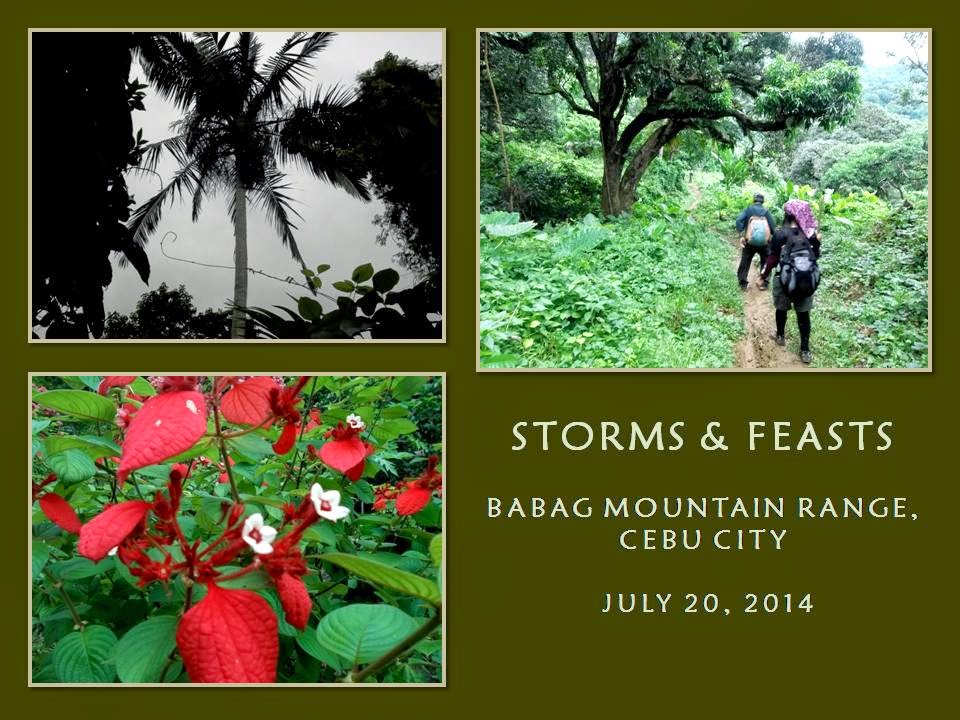
BUSHCRAFT BUHISAN XXVII: “Riders” of the Storm
THERE
IS ANOTHER WEATHER disturbance named “Henry”. It is not a
hindrance to me on my outdoor sojourns. It may be a nuisance to
others but it would never ever be a reason to postpone an outdoors
activity just because it caused one a not-so-perfect day. A wet
disposition, a cold atmosphere or a muddy trail are the least of my
concerns. I just focus on the totality of the journey and bad
weather can only lend a color to it. Nothing bad.
It
had been raining since last night and this morning of July 20, 2014
is a bit cold. I will have to “ride” out the storm then. I am
leading five others cheerily up “heartbreak ridge”. Rainclouds
are a blessing up here on this exposed ridge of Banawa Hills whose
features imitate the back of a giant lizard if you see it from
Mandaue. The power pylon now sports a signage with a smiling skull
which seemed to relish at the word “DANGER”.
Behind
me are Jhurds Neo, Jingaling Campomanes, Nelson Orozco, Ernie Salomon
and Nyor Pino. The bottom of the ridge where there used to be a
cairn are now behind us and so is the Our Lady of Guadalupe Parish
which we had left at 07:15. We got past the tower and the World War
II tunnel vent and met three perspiring youths with firewood on their
shoulders going to where we came from.
We
are now among farms of cassava, lemon grass, horse radish, corn and
sweet potato but the hard packed trail cant downward and I take it
slow as it is slippery. Ripe fruits from a Chinese laurel tree
(Local name: bugnay) provide us something to relish. Old
fruit trees populate the path but it is not the season for mangoes,
tamarinds, star apples, breadfruits and Spanish plums. Met a man
carrying a sack of avocados on his head. The route goes into
different saddles until we reach the place called “the Portal”.
It
is 08:30 and I need to reach our destination, which is Camp Damazo,
before 11:00 but, infront of me, is the old trail that lead to it.
Ernie insists on using it. It is long, difficult, gloomy, wild and
it is a trail that I had last walked in 2012. Sounds foolish when I
had already been using a shorter route. Well, I do not have to
switch to “Plan B”. We take a muddy detour for Baksan Road. All
of us are wet and I am happy to see that no one is wearing a rain
coat.
Rain
coats, for me, are for school children, for higher altitudes and for
corporate people. Bushmen do not wear such, not in a tropical
jungle, and they improve their resistance by adapting to the elements
of nature. Exposure to rain and cold prime up my senses and I do not
want it in another way. If you want comfort, then do not go out of
your house on a rainy day. Watch TV on your warm sofa and drink hot
milk.
We
go down the trailhead where it led to a dry stream then go up a
ridge. We are now at the teak forests of Baksan. I follow another
ridge going down a low saddle and then into another ridge that climb
up a hill which I liked to call as “Boy T’s Hell”. Ernie takes
a dig at Boy Toledo, who is not present, as he recalled the latter’s
dark skin turning white after climbing this low hill from another
very difficult route. Very amusing story since I was there and it is
worth telling. With a laugh!
We
cut straight branches from teak trees so we could use it as walking
sticks. This type of teak planted here is not an indigenous species
but originally are from Burma and are not very receptive with birds
and insects. It is a boon instead of a blessing. It does not make
the soil fertile and does not like to share space with native tree
species. Even with that, we carefully choose which branches to cut
that would result to an even healthier tree.
We
go down the hill and I looked for my trail sign. Found it and I see
the route I took last July 5. I was alone then engaging on “Survival
Day”. Three teak trees growing in between, I used as springboards
to aid people during descent, after which it cross two small gullies
and weave in and among low trees and shrubs until you reach a trail
beside a stream which I designate as Creek Alpha for want of a name.
Vegetation are now wilder here with different varieties of indigenous
plants and trees.
I
cross the stream and I see a single footprint on the sand. It
belonged to a small man. Beside it is a paw print of a dog. It is a
couple of hours old. I am now on the other side of the stream bank
and I follow a path. I go down a branch of the trail which lead to
the same stream. I need to check on the old location of Camp Damazo.
I see a deep imprint of a paw, most probably of that same dog. I do
not see traces of the man. Perhaps it is a dog trained to hunt.
Dogs like that move a lot without waiting for a signal from its
master.
The
old campsite is just a small tongue of even ground between the
confluence of two small streams. It could accommodate about five
tents but during the first Philippine Independence Bushcraft Camp of
2011, it was filled with nine tents housing fourteen participants,
which Ernie and Boy T were part of. Water source then came from
water holes dug beside the stream.
I
do not like crowded campsites, that is why I transferred Camp Damazo
to a better but safer location and that is where I am going to now.
We leave the old campsite and go back our way but I change direction.
The ground and foliage are so moist that we found it hard to look
for dry dead leaves. I found dead branches with dead leaves hanging
onto it. I select dried ones and we fill up a small plastic bag.
I
follow the trail as it wind along the contours of the terrain and I
see the same footprints. The hunter placed overturned rattan leaves
on the ground. It is purposely done that way so he could find his
way back and the lighter shade of the leaf’s underside could be
seen better in dim-light conditions. It reflects light better when
probed with a LED torch. The man used his head well or it could be
that he learned it from others.
Blocking
the path before me are two slender branches of a teak tree bent
towards the other side. I thought it at first as a spring mechanism
for a snare but I do not think so. Teak wood are not stiff and would
easily bend but does not snap back when released. I looked closely
and I see no cords but he placed crawling ferns over it. A debris
shelter! So he must have waited for a prey and, that means, he is
armed with a hunting rifle. So that is why his footprints have deep
imprints?
I
looked all around to guess where would he aimed his rifle sight?
Surely it would be high on a tree but which tree? I see traces of
somebody sliding down a steep hillside. So he must have hit his
prey, probably a jungle fowl. No fool would go down that steep
ground where I stood at without something to gain from. As I see all
these series of events reading the tracks, I expound it to my
companions, including a trail sign commonly used by “other people”.
We
reach the second stream which I named as Creek Bravo. Somebody just
harvested three bamboo sprouts (dabong) here where it is
peeled on the creek bed. It came from the groves of water bamboo
(botong) located just above us. There is no visible water on
the stream but there is one underneath. Growing and clinging on a
mossy stone are two young plants with glossy leaves which I suspect
to be Philippine ginseng. Strangely unbelievable but I based on the
peculiar design of the leaf edges but I could be wrong.
Nevertheless,
we have to go. It is now 09:25 and the sky starts to open up with a
slight sunshine touching the tips of leaves on the highest
elevations. The path is muddy but all behind me knows how to deal
with it. The Leave No Trace teaches people to “walk single file
even if it is muddy”. We do not do that because we always think,
we improvise and we adjust well to a situation. Common sense is much
better than following a foreign ideology that had been ruthlessly
made a rule by corporate outdoor clubs instead of as a guide.
I
saw many muddy paths turned into “water slides” when people
without real-world skills follow that dictum and gave locals a hard
time to travel from their farms to the market and back and also for
the children from their homes to their schools and back. That is
really careless and downright aloof without regard and respect for
the locals living on the mountains just because you want to portray
yourself as a champion of the environment. Remember, they had been
content of their lives for years until you came one day and made it
miserable.
Anyway,
we follow the path ascend to a ridge. In a short while we would be
at Camp Damazo. My wet Silangan Greyman pants snagged on a
rattan tendril and I slowly remove it. Steadily, we hike uphill and
come upon a reddish cuckoo dove (tubaon) foraging on the
ground. The small dove had not noticed our coming until we are near
and it flew. We collect firewood as we walk until I see the “gate”
of Camp Damazo. PIBC products - Ernie, Jhurds and Nelson, had
learned well and all used their wits.
Dry
firewood are hard to find, especially during rainy days, and it is
rather difficult for people without basic survival know-how. I
taught people how and why everytime I convene the PIBC or you may
study my trail habits and be attentive when I am on a day hike. I am
very generous when it comes to sharing knowledge and I always explain
when I think there is an importance or I may find you very interested
in what I do.
This
campsite had been found and chosen during PIBC 2012 and revisited in
PIBC 2013. Outdoorsmen from Luzon came here to learn bushcraft and
survival on those two occasions and this place had produced the
finest products yet of the PIBC. When coffee seedlings were planted
here, I decide to respect the locals who nurtured these and
transferred the 2014 edition in Sibonga. Besides, the campsite had
widened during brush clearing by locals for their coffee seedlings.
As
I meticulously break off dry twigs in pencil-lead sizes, pencil sizes
and thumb sizes, Jhurds chopped small branches with his Spyderco
Forester bolo. Nelson and Nyor make a “bird’s nest” of dry
tinder and kindling. With a spark from a ferro rod, the tinder emit
smoke and Nelson blow it to life. I placed my smallest twigs over it
as the smoke thickened. Fingers of flame sprouted and it blazed more
when bigger twigs are placed over it. Ernie automatically work on
the food ingredients while I produce blackened pots.
We
boil water for coffee first for hot coffee gives you heat, quenches
thirst, makes you think better and unload a lot of tales. Nelson
provide a small fire placed on a different location. Its purpose is
just to provide thick smoke so mosquitoes and ants do not torment us.
A pot hang suspended from a tripod and over a fire. In it is a kilo
of rice. We will be having another “feast”, especially with
Ernie around. Cooking on a dayhike is a trademark activity of the
Camp Red Bushcraft and Survival Guild.
We
do this because we do not hurry. Haste creates waste of quality time
and energy and exposes you to accidents. Quality time is learning
new ideas and knowledge from people and learning to appreciate nature
better. Ernie cook a mixed-vegetable soup and blood clam (litob).
Jhurds provide entertainment. Jingaling takes care preparing raw
cucumber in vinegar while local sausage (chorizo) is grilled
over coals. We eat lunch at 13:30 under a very breezy condition.
We
leave after storing back our things to our backpacks. Oh, yes, I
carried the Silangan Predator Z today and so is Jhurds with
his Predator Alpha. We reach Baksan Road at 15:15 but we
continue on to Lanipao and take refreshments. We proceed to Napo
where we end our walk by riding motorcycles-for-hire for Guadalupe.
We did not tarry long and we all decide to omit the post-event
discussions as everyone are exhausted.
Although
doing an outdoors activity during bad weather is not advisable, but
you would have to do it sometimes. You have to prepare yourself
physically and psychologically by training in a real-world situation
because the really bad ones are those that hit you where you least
expected it. “Murphy’s Law” is a demanding adversary which
nobody had gained advantage of yet. But a prepared mind knows how.
Document
done in LibreOffice 3.3 Writer
Posted by
PinoyApache
at
10:00
0
comments
Labels: Baksan Forest, Buhisan, Camp Red, Cebu City, trailcraft, training
Subscribe to:
Posts (Atom)