Showing posts with label MCAP. Show all posts

Friday, March 11, 2016

ALLIANCE MATTERS VI: BMC 2015

THE SUCCESS OF THE Philippine Independence Bushcraft Camp, which had just ended yesterday, had left me in a stupor and quite tired but, by all means, I have to honor a commitment. Today, June 13, 2015, the Cebu chapter of the Mountain Climbers Alliance of the Philippines, with support from the Visayan Trekkers Forum, would give another Basic Mountaineering Course for the new set of individuals who are lured to the wonders of the mountains.

This local version of the MCAP's BMC, is the brainchild of Barry Paracuelles, who saw it a need to educate people about outdoor ethics, the technical aspect of mountaineering and pure common sense. This would be the second time that Barry is organizing this. Last year it was held in Sibonga, Cebu and, this year, it will be located at the Boy Scout Camp in Kalunasan, Cebu City. Just like last year, I would be one of the resource persons.
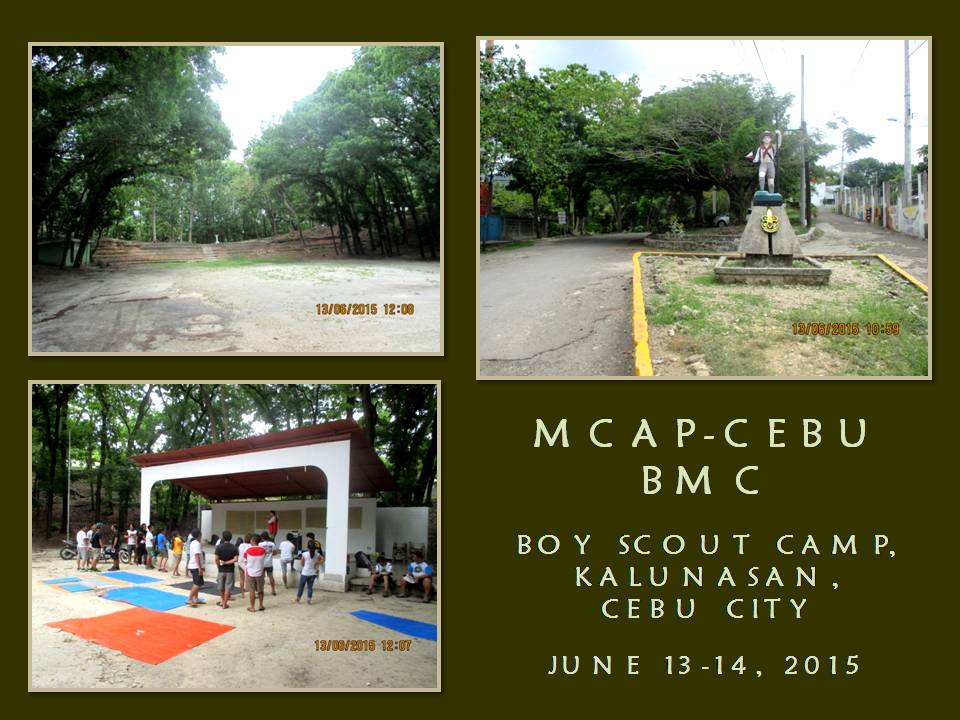

I shrug off my lethargy and commute to the site. I had not awaken earlier as I had planned but I willed myself to be there. It is almost 11:00 when I arrive and the participants are busy drawing up their test itinerary on pieces of Manila paper with black markers. Barry had chosen the amphitheater area for the seminar and there is a stage where each of the three groups are instructed to explain to everybody.

After lunch, Barry continued with his discussion. He provided a sound system for the microphone; and a laptop and a projector for visual learning. After about 30 minutes, I am next. My topic would be about the Survival Kit; Water; and Cold Weather Survival. These were the same topics that I had talked about last year and I am excited to impart my knowledge to this new batch of participants.

The Survival Kit is a very important piece of personal equipment that may be useful with its owner and to those who are with him/her. Although the absence of it is not life-threatening but its presence will somewhat give you some peace of mind. The kit does not necessarily be contained in a single container and, in fact, consists of several sub-kits like the First Aid Kit, Replenishment Pouch, the Repair Kit and the Survival Knife.

The kit is nothing but a replication of your regular equipment but quite small so it could fit inside a small container. There is the extra LED light and some extra batteries; an extra whistle; an extra lighter or an extra set of matchsticks; an extra paracord; an extra knife; an extra of everything. Remember this – redundancy is security; and it is not difficult to assemble this. Then you place in an emergency power bank to give life to your mobile phone, a camera, a GPS or gadgets.


The First Aid Kit is the most important component of your survival kit. It should contain medicine for ordinary ailments, betadine solution, isopropyl alcohol, cotton balls, gauze bandage and surgical tapes. I used my IFAK as a demonstration tool for it contains, aside from the mentioned items above, a host of other things which could be very useful during emergencies like a tourniquet, a triangular clothe, an emergency blanket, rubber gloves, trauma shears and a generous roll of surgical tape.

The Replenishment Pouch contains your extra cache of nourishment that you may need when you ran out of regular food which you had budgeted for a trip. It may be high-nutrition food or an MRE pack with a sprinkling of coffee, chocolate and powdered juice or milk. During emergencies, when your itinerary extends to a day or two, this particular sub-kit would come in very handy.

The Repair Kit may not be important but it is a good option if you have one. Its most important attribute is that you can do repairs on the field. A packaging tape with you could do almost all things like patching up a torn tent, saving a sole from separating from the shoe, covering a wound bandage and wrapping a splint. A needle-and-thread set, an epoxy tube and some safety pins would make you appreciate this sub-kit.

The Survival Knife, if you wish to incorporate it as one of your equipment, does not have to be expensive or with a complicated design. It does not have to be very heavy but it should be sturdy enough to handle rugged work. A locally-made knife of about five to six inches in blade length is enough since these kind of knives are very efficient in a tropical setting. Make sure that your knife is encased inside a sturdy sheath like hard plastic, PVC, wood or thick leather.

If you insist to buy imported brands, choose the Mora knives of Sweden. These are efficient and easier to maintain and I have seen it personally how it performed for I own one myself. Another imported knife that you should consider is the Swiss Army Knife, preferably the ones with new design because the blade is longer and choose also which has a folding saw. The saw design of the SAKs are superior in performance compared to other multi-tool brands.


After this, I proceed on to the topic of Water. Water, as we know it, are often taken for granted in the tropics yet it is a source of conflict in other places. We have an abundance of it even during drought. This topic teaches the participants the wisdom of constant rehydration and constant refill of water bottles when an opportunity presents. It also teaches them where to find the safest water and, when its potability is suspect, how to process these.

My last talk is Cold Weather Survival. These are the physical mechanisms that slowly wick away body heat and, without our knowing, would leave us colder than we were and would lead to hypothermia or shock. In highly-elevated areas, this is deadly. These are Respiration, Conduction, Convection, Evaporation and Radiation. Thankfully, there are methods to counter these like insulation, layering, covering up of vulnerable areas and constant awareness of physical exertions to keep respiration and perspiration under control.

Barry takes over from where I left and pursues his discussion about the types of backpacks and tents and loading techniques. Neil Mabini of VTF proceeds to discuss his which touches about Knots and Knot-tying. Later, he rigs a single rope on a high branch of a tree and demonstrates Single Rope Technique with the use of prussik knots. A few bold participants decides to go up and down a 7.5 mm rope.

I decide to pitch my Silangan hammock between two mahogany trunks when it begins to rain. Rain is a rare occurrence nowadays due to the onset of a mild El Niño weather. Rain are supposed to be felt at this time of year in great abundance. Nevertheless, I am able to rig my Apexus fly sheet over my hammock and tied its ends from wooden pegs which I sourced from a low branch of an arbor tree before the rain came.

Although the Boy Scout Camp is abundant of trees, you would not see a low-hanging branch because it is harvested by outsiders for firewood. The arbor tree's branch is not really that low and I have to jump high to reach its nearest part. It was done through quick thinking instigated by a backdrop of a few minutes of daylight left and by the possibility of oncoming rain.

After the day, dinner is prepared by all. Next comes the socials. Lively talks and jokes spurred on by Chad Bacolod made the company I am with very alive supplied by almost endless rounds of strong drinks which, altogether, raise the crescendo of laughter. It is near midnight when I burrow into my cocoon for the night. The night is cool and I feel nostalgia.

Some forty years ago, I came here for an overnight camp as part of a contingent of boy scouts from the Colegio de San Jose-Recoletos (now USJ-R). It was at these same grounds that I helped pitch a tent assigned to me and two others. The tent was made of Army canvass. We set it up in A-type fashion. Draft would pass thru between canvass edge and ground and I remember waking up with part of my head protruding from this gap. It is just pleasant to reminisce this.

I wake up the next day, June 14, at almost 09:00. Oh God, I am tired. I have been tired already by three days of teaching bushcraft to another set of people in Lilo-an, Cebu and now another two days for the BMC. One participant, Fritz Jay Hortelano, attended both outdoor seminars and, I can say, he is now a complete and responsible outdoorsman. His knowledge gained from both camps would sit him well among peers.

Neil, together with the other participants are on the other side of the camp for an abseil session. Those who stayed prepare the meals. When the rest arrived, brunch is served. I take two refills. Then the BMC certificates are distributed to the participants. In appreciation, they gift Barry, Neil and me a brand new Nalgene bottle each. After the photo sessions, the seminar concludes.

The BMC will be offered free for as long as there are dedicated people like Barry, Neil and Chad. Taking this seminar would make a big difference on the individual and on the environment where he/she will choose to visit. The more responsible people visiting the mountains, the more vibrant will the mountaineering community be.


Document done in LibreOffice 4.3 Writer


Tuesday, April 7, 2015

ALLIANCE MATTERS V: Sibonga BMC

I AM STILL NURSING a fever borne out of a motorcycle accident that I got into on the night of July 29, 2014. My left chest is in pain, probably a slipped cartilage, and breathing is quite stiff. I also have a pulsating headache, a runny nose and an itchy throat. Yet, despite those, I am game enough to lend my presence, my time and my knowledge before outdoors enthusiasts today, August 2, 2014, at the Green Habitat Resort in the hills of Sibonga, Cebu.

When I gave my commitment to Barry Paracuelles a week ago, I will pursue it, no matter what. Like today. I was even getting too restless to look forward to this day that I am deprived of a good sleep the night before. I am excited to work with my local peers of the Mountain Climbers Alliance of the Philippines Inc. (MCAP), who included me as resource person for a Basic Mountaineering Course. Barry had designed the program of this BMC and this is, I think, a different kind of BMC.

I woke up at 04:15 and out of my home after a cold shower. The participants will converge at the 7Eleven across the Cebu South Bus Terminal while Barry had designated the office of Primary Structures Corp. in V. Rama Avenue as the meeting place for the organizers. By 05:00, I am already at the place. Since Barry had not arrived yet, I decide to enjoy coffee and bread at Pan de Manila at the nearby M. Velez Street and buy ingredients for my meal at the Guadalupe Public Market.


We leave at 07:00 for Sibonga. Primary Structures, where Barry worked, provided us free transportation. Some of those that will take the BMC are employees of Primary Structures. Got to hand it to Barry for organizing this event more than what I had expected it to be even to the extent of involving the company where he is working along with his co-workers. I believe that the main body of participants had left the assembly area as well in a bus.

When we arrive at the Green Habitat Resort, some of the participants were already there. I examined the place and it is a resort alright with five pools, a camping ground, a stage, several cottages while a creek runs beside it. The ground had been leveled off including the part where it once was a slope. I take a seat at the farthest kiosk where I am joined by Neil Mabini, Chad Bacolod and Xerxes Alcordo.

Barry immediately led the setting up of the sound system and the projector on the stage. I offered my Apexus tarpaulin sheet as an improvised projector screen. As everyone settled in among the PVC chairs, Barry started the BMC. The projector throw images from the laptop to the tarp sheet but daylight defeated the purpose. Nevertheless, Barry explained every detail of each chapter until such time when lunch break came.


After the meal, the lecture transferred to one of the cottages and the discussion of the BMC by Barry continues. By 15:00, my turn came. My topics are The Survival Kit, Water and Cold-Weather Survival. Some of the participants are a bit bored and sleepy so I decide to let them stand up and asked them to give 15 seconds of silence to the memory of Aldrin Cerba, who died during a canyoning accident at Canlaob Canyon in Alegria.

The first topic, The Survival Kit, cannot be discussed without a real survival kit. Of course. It is a very complex subject that would involve the exhibition of all the items found in a survival kit plus the WHYS and the HOWS of why it is part of the kit. The delivery of the lecture fluctuate between the hilarious, the serious, the scientific and the interesting. At least, I get the attention of the participants, most of whom are still new to the outdoors.

The survival kit, I explained to all, also consists of the different sub-kits like the first aid kit, the repair kit and the replenishment pouch plus a good knife. The knife could either be a fixed blade but very light like the Mora or the different versions of the Swiss Army Knife, especially with one that has a folding saw. One of the very important components of your survival kit is the thermal blanket, which you should have since you tend to visit higher altitudes, and fire tools, the redundancy of which ensures your overall security.


My next subject matter is Water. Water, I inform to all, are very abundant here in the tropics but is a commodity that had caused conflict in other places. Outdoor activities like those done in mountains demand water so much because dehydration is a natural process of the human body. You cannot remedy loss of body moisture except rehydrating several times as you can and filling up bottles whenever you can. Taught them of the places where to source water and what methods of treating water before drinking.

Last is Cold-Weather Survival. Since mountaineering is a high-altitude activity where exposure to cold is high, the best way to prevent hypothermia is to know the five mechanisms that steal heat away from your body: Respiration, Conduction, Convection, Evaporation and Radiation. For every natural heat-loss process, there are remedies for that which I clearly explained. When I thought I have reached the end of my lecture, I let them examine all the items of my survival kit.

Neil came in next with Technical Climbing. He discussed about the different ropes, its usage, care and storage. Apart from that, he showed and discussed the safety gears that are used with the rope during technical climbing like the harness, carabiners, descenders, flat webbing and cords, mechanical ascenders, chocks, etc. Other accessories like the safety helmet, rock shoes and chalk bag are properly explained according to its purpose.

When ropes and cords are involved, surely there would always be knots. Lots and lots of tying around. Ropesmanship is another topic that Neil is discussing to all participants for the rest of the afternoon. He taught the basics of knot-tying and the most common knots used in mountaineering like the square knot, the bowline, the figure-of-eight, the double bowline, the double figure 8, the Prussik knot, the munter hitch, the Kleimheist, etc.


The knots and all the equipment are then used for the Single-Rope Technique, a method of traversing up and down vertical places using the rope instead of a ladder. Neil showed everyone how to use the ascender and how to devise the cord to work with the ascender and your harness to gain altitude. He shows the technique in how to uncouple the ascender and transfer to a descender when he needs to go down. A belay is used to increase safety for the first timers.

When dusk came, everyone settled to their respective groups. There are several informal outdoor groups which carry funny names like Tribu Batig Nawong (literally, ugly faces), Yabag (unmelodious voice) and Orcs (they are not from the Lords of the Ring); and the serious ones like the Enthusiasts of Cebu Outdoors, Visayan Trekkers Forum and RECON MACE 7.

When I had ended my lectures, I set up my Silangan “stealth hammock” between two midget coconut palms. Overhead cover is my Apexus sheet which is anchored at its edges by sharpened wooden stakes. That would be my resting place for the night which, I believed, would be long. When fixing my shelter was finished, I start preparing my dinner. For this occasion, I brought my almost-forgotten butane stove.

After the SRT session, everybody gets busy preparing their own food. Each group has its own concoction and I thought I saw a bottle of hard spirits but I declined an offer of a drink. I believe the gut needs a filling first and it is still too early. A spoon rapped on a pot lid signaled the start of dinner. In a flurry of refills after refills, the food gets decimated and everyone are too bloated to make crazy somersaults on the swimming pools.

The groups are to each his own now and I carefully evaded the attention of the ones holding the bottles until I get to enter an open cottage and I got trapped with a group who knows my son very well as they are working in the same company. They are with a little-known business process outsourcing company located at the Cebu IT Park called Microsourcing.


They are now serious outdoorsmen and they asked me everything about “Mag-ne” and why I hid my face with different books on my Facebook profiles? I give them funny answers that tickled them to the bones especially now that the spirits in the glass begins to work on all of us. The rounds of the glass becomes tighter and faster and the laughter begins to get boisterous. Outside is pandemonium as some of the participants begins to make the pools work for their enjoyment.

When I thought I have enough, I work my way into my sleeping quarter. Fortunately, it is empty of stragglers. This would be my first night on my Silangan hammock and I am trying this for the very first time as a half-conscious occupant of a few hours. A built-in mosquito net protects me from those noisy insects and that gives me an assurance of a good night’s sleep, a peace of mind. The hammock is quite spacious which I had not experienced with old hammocks that I used before.

Indeed, the hammock worked wonders as I see daylight of the next day, August 3. Coffee are available everywhere but I kept to myself with my own supply which I get to share when someone overshoots his orbit. The rappel session starts early under the direction of Neil while I assist him with the belays. When it was over, the whole BMC class with their certificates takes a pose for the cameras. After that, everyone gets to relax and takes another dip in the pool as the bags are packed ready for departure.

BMC classes are now very common that it is now given free. This BMC, to keep abreast of the times, is given en gratis and would be a first in the annals of MCAP to be held outside of Luzon. However, Barry choose to involve topics which had not been discussed before in any level of any BMC to equip better the participants by its practical applications in the enjoyment of their interests among our mountains.

Because of that, I was moved, at the instance of Barry, to make better mountaineers and better individuals of the participants. I could not have been more happy than to become a catalyst of increasing their safety in the outdoors and of their survivability as well.


Document done in LibreOffice 3.3 Writer

Monday, September 1, 2014

ALLIANCE MATTERS IV: An Osmeña Peak Reverse by Team Tamad


WHEN I POSTED AN ARTICLE about the seldom-taken reverse route to Osmeña Peak which I hiked last August 2013 (Reversing the Trend), three mountaineers from the Mountain Climbers Alliance of the Philippines, Inc. (MCAP) took this as a challenge and contacted me to engage in it.  I then requested Maria Mahinay to create an itinerary for this so as to accommodate the wishes of the trio from Team TAMAD:  Kris Shiela Mingi, Gene Arceno and Julius Roman.

Osmeña Peak is named after from the most illustrious son of Cebu – President Sergio Osmeña Sr. - because of its lofty location, being the highest point of the island province at 1,015 meters.  It is located within the Southern Cebu Mountain Range and, contrary to the common perception, is really part of the Municipality of Badian.  Local mountaineers used to approach it from Mantalongon, which is on the Dalaguete side, and is just a stroll in the park.  The peak is, thus, relegated as just another leisurely picnic area which I do not like.


Almost everyone thought that it is unthinkable to hike Osmeña Peak from Basak, Badian and all would rather take the easy route from Mantalongon and then take their chances downhill to Badian.  Daunting as it may seem, a few intrepid hikers had successfully tackled this reverse route and had given meaning to the climbing of O-Peak and of the totality of their journey.  It is best to start the climb early morning during warm days and, if it could not be avoided, is totally safe during rainy days as there are no streams to cross to.

Today, January 11, 2014, I will again return to the Southern Cebu Mountain Range to accompany my guests from Luzon.  Local MCAP members Maria and Barry Paracuelles are also coming in.  Barry is with his wife, Eva Marie.  We start at 4:00 AM from the Cebu South Bus Terminal on board a Ceres Bus bound for Badian.  It had been raining since last night caused by a Low Pressure Area approaching Mindanao and a lull had been experienced during travel until we reach Barili when it rained again.


After taking a light breakfast at the public market in Badian, Sien Alfanta, Ed Dablo and Neil Mabini arrive to boost our number.  Then comes Jodel Seville and Charito Matollama and that makes us twelve.  Although this is a dayhike, most of the participants will spend a night in Oslob and so have brought with them bulkier gears like tents and sleeping bags and some extra cargo.  We leave the market for the trailhead in Basak and start our hike at exactly 8:00 AM. 

I  travel light today and just brought my EDC kit, a trauma kit, a dry shirt, a rather heavy LED torch, a Cignus V85 UHF-VHF radio and a liter of water.  Going along is my Nessmuk trio: a William Rodgers bushcraft knife, an AJF Gahum heavy-duty knife and a Victorinox SAK Trailmaster.  I do not open carry a knife today because this is an entirely different activity.  My Kodak EasyShare digital camera is in the pocket of my Silangan Outdoors hiking pants.  A Buck 112 folding knife is kept in the beltline behind a Victorinox operator belt. 

Sien, Ed and Neil will spearhead the trek while I backstop the rear.  That relieves me of pressure and would extricate me of possible accidents as I chose the wrong pair of shoes for this occasion.  Anyway, as last man, I could take it easy on my pace and I could focus more on documentation and taking pictures freely, although sparingly, as I would not want to ruin my camera under the threat of this light downpour.


Neil and company started from the Basak communal well and climbed up a steep snaky route that pass by small plots of spring onions, corn and cabbages gouged out of rocky terrain.  The rain kept up a steady torrent but all burst with a high spirit of excitement and adventure and shut away the discomforts of cold and muddy trails.  Walking in foul weather are for the stoutest of hearts only and the people I am with did not waver from this hardship and that satisfies my expectations.

When you would want to develop your stamina and your resistance to the elements, you would need to keep only the bare comforts and become used to it.  Then you complement it with a good elevation gain which this route will provide.  You start low at Basak at 235 meters and gain 780 meters upon reaching the crown of Osmeña Peak which you cannot achieve if coming in from Mantalongon.  Aside that, you walk a steep incline of about four kilometers in length which is also impossible to get from Mantalongon.

We reach the small village of Malagaring at 8:55 AM and a local offer us free cups of coffee.  He is very happy that some of whom who went with me today sponsored a Christmas party for the children last December.  Nobody could beat charity and goodwill.  It would always open doors and windows and, here in the mountains, it will open wide as I have had done so in my own Babag Mountain Range.  If only more outdoorsmen would include charity works in their activities, trails that had lain invisible to outsiders would be happily given.


Neil and company follow a different route than what I took last November 17, 2013 and then it arrive to a point where the route they had chosen is the same as mine for about a hundred meters until it crossed a farm and it became totally different again.  This time it is more muddy and slippery and our footfalls are now forceful to get a good grip.  It is quite taxing to gain a foothold especially if you are wearing an old pair whose soles had seen better days and water ooze in among the hairline cracks.

What I lacked in good footwear I compensate with less of LNT.  Yes, I am no fool to just walk in the middle of the trail that is muddy where puddles of torpid water are present just because it is stated so in the Leave No Trace.  Forgive me but my common sense is better than that foreign ideology which was designed for terrain in temperate zones.  This is the tropics and our two seasons are conducive to speedy regeneration of vegetation.  I deliberately stepped on a lot of vegetation because I know better.

We keep up a steady ascent and the guests from Manila were up to the challenge.  Gene would take short rests but I keep my distance so he would spend a lot of it without worrying about the next person coming, which is me.  The route goes in a small patch of forest and, as it thinned, farms.  We reach the small village of Patong at 10:45 AM and it is a chance to quench thirst with soda drinks.  I opt to drink my supply of water instead and eat sweet buns which I bought at a bakery in Badian.

 
Although we started an hour late, we compensate for that by pacing fast and reached our rest stops with more than an hour to spare; muddy trails were not a hindrance though.  From what I ascertained, most likely we would be at the peak before noon.  We leave Patong at 11:10 AM for the last push for the top.  The rain had stopped but it is replaced by strong gusts of wind.  Wind chill factor is high but the guys had taken food and had a drink to replenish spent reserves of energy exerted in going up here.

The trail is decked now with broken lime stones, foreboding a great concrete coverup in the future.  This route would lead to the saddle where a concrete road had stopped.  We took a different trail that branched out from this route and it is muddy again.  It pass by hilly farms of spring onions, cabbages and vegetable pears until the trail weave out along the contours of roundish hills which gave a false impression that you are in the vicinity of O-Peak.  The pace became hurried but I keep to my own comfortable speed, taking on the scenery with my camera.

After a final turn below a false peak, the Grandfather Mountain of the South stood in mute silence without its shroud of mists.  We reach the top at exactly 11:30 AM and, by God, we were fast.  The cold winds are not hospitable in this exposed spot but we held onto dear ground by putting weight were wind is most felt.  I test my portable radio on an arranged frequency but the reception is not good although I could pick up very clear signals from harbor traffic and from a weather station.

I congratulated Shie, Gene and Julius for snaring Osmeña Peak the hard way and, probably, would be the first done by Luzon-based mountaineers coming in by way of Basak.  It is a textbook reverse traverse hike that will soon terminate in Mantalongon.  When the guests had their fill and had fixed the apex of their quest with photos, we slowly go down the hill into the breadbasket of Cebu – the high valley of Mantalongon.


It is raining hard now and the trail is very slippery, especially at the lower approaches, but when we had reached the road, we begin to feel that we are now in home territory.  We reach the public market at 1:00 PM and take a deserved lunch at a local restaurant.  It is still raining outside and windy and the inside of the restaurant is comfortable but we have to leave for lower ground to talk about the Oslob trip.  Six motorcycles accommodated us all and we go down the main highway located at sea level.

Shie, Gene and Julius had to shelve their Oslob trip as the waves spun by the inclement weather are not encouraging for whale watching.  We stay for a while at Dalaguete’s waterfront park for four big bottles of cold beer to fill up lost electrolytes.  We go back to the highway when we think that the rain would not stop for a bus back to Cebu City.  What people do not understand is that you get a good chance to ride on a half-empty bus in Dalaguete than that in Badian.  We just did that and we reach the big city at 7:30 PM.


Document done in LibreOffice 3.3 Writer

Friday, May 16, 2014

ALLIANCE MATTERS III: Basic Wilderness Survival Course 2013

I LEAVE HOME AT 2:15 AM. Three hours from now, I will be in Metro Manila, October 18, 2013. I have to honor a commitment with the Mountain Climbers Alliance of the Philippines, Inc. and, that is, to conduct training about survival among its members. I have done so last year on a program borrowed from the Philippine Independence Bushcraft Camp. It was held then at the slopes of Mount Balagbag, Rizal.

This time, I have designed a training program for mountaineers. It is called the BASIC WILDERNESS SURVIVAL COURSE and it will run for three days. My Sandugo Khumbu 40 Liter backpack is heavy as I follow the line to check in at the airport. I had already separated my EDC Kit from the bag and, when my turn came, the bag weigh in at 13.9 kilos. I have a 15 kilogram limit and good thing that I had handcarried my EDC Kit (minus the sharp ones) else I would have shelled some extra peso.


The plane left as scheduled but it arrive a bit early. I inform Pastor Reynold Boringot that I am at Gate 4 of NAIA 3. I place my EDC back into my bag and waited. When we meet we transfer to an MRT station and I begin to worry if my bag would have to be searched thoroughly. I have known that a lot of commuters had been denied entry carrying knives during inspections at the MRT and confiscation if they insist so and I carry a lot of blades!

In my arsenal is an AJF Gahum knife, a Victorinox SAK Trailmaster, a William Rodgers, a Case XX folder, a Greenfield pocket knife, a tomahawk and a couple of small pointed metal files. A lady guard checked my bag as I opened it. She paused and put on rubber gloves and continue searching. I noticed something sticky when I remove some items so she could search thoroughly. But at the last second, she stopped and I gladly returned the items. I am quite confused about that sticky substance though and where it came from?

I follow a stream of commuters into the loading bays and when a train made itself available for loading, I chose a seat while it is still blissfully empty. Reynold did, likewise, and the MRT move on north for East Avenue were we disembark and walk towards the meeting place right across the Land Registration Authority. We take breakfast at a Jollibee outlet and I meet MCAP members, Aleks Ibo and RV Abiad. From there, we proceed to the second meeting place at Cogeo Market where Jay Z Jorge and Carla Tipon are waiting.


When we think that nobody had arrived after us, we proceed for Antipolo and then to the Nuestra Señora de Buenviaje Parish of Old Bosoboso. From there, we walk the route to the Spring of Life Adventure Camp. The resort is empty of people and had been left idle by the owners but it is still functional. I choose the highest ground where there is a kiosk. The structure has a space above it that could be used as a sleeping quarter while all around the campsite are verdant vegetation where a lot of bamboos grow.

Everybody opt to stay upstairs and set up their hammocks and a free-standing tent while I choose to set up my shelter outside. It is an Apexus taffeta sheet rigged with a flat rope as ridge and secured by bamboo stakes to stretch it wide. A discarded advertisement tarp becomes my ground sheet. There are officially five participants as of yet but it does not matter. The smaller the group, the more compact will the instructions be.

Jay Z handed me a package wrapped in cardboard. Dr. Arvin Sese, owner of Seseblades, had provided me, for free, of several knives for use on this occasion and to handcarry the rest to Cebu. Inside were a JEST bolo, a Hudson Bay knife, six Sinalung knives and two NCO knives. The bolo and the sinalung had the trademarked Igorot-inspired wooden sheaths. I know all the blades are made from the leaf-spring steel of a Willys Jeep. Aside mine, Jay Z was given a parang, a sinalung and an NCO knife by Doc Sese.

I start a small fire and show them how to process charclothe. After lunch, I begin the lectures. It is the Introduction. Once I have explained to all about the survival mindset and psychology, the hierarchy of needs, nutrition and hygiene, I proceed to the Survival Kit. The survival kit should include the first aid component, the replenishment pouch, the repair pack and the survival knife. Closing the day’s instructions is Knife Care and Safety. I talk about Batas Pambansa Bilang 6, knife etiquette, safety carriage, honing techniques and the Nessmuk system.


Ryan Dizon arrive in the middle of my discussion but I do a recap of the earlier chapters which he had missed and it goes all well. We prepare our dinner and it is a sumptuous meal under the bright light of a full moon. I noticed that Manila-based mountaineers prepare their meals exquisitely compared to those from Cebu. I get to taste good food which comes in three different courses which is rather rare in an outdoors setting.

When I thought that the rest of the day would turn out right, I was wrong. After I have prepared myself against mosquitoes, covering myself from head to toes and spraying myself with citronella, they came with their ubiquitous noise. Why, of all places, they prefer to hover near the ears? I tossed and turned on my search for sleep only to be struck by a much more sinister creature: fleas. I did not know that grass harbor fleas but, here they are, biting me everywhere.

I tried to ignore the flea bites and them mosquitoes but these are very insistent. The hours drag by slowly as I waited for daylight and when it did, I found the lower half of my ground sheet already out of the shelter due to my frequent movements. Sunrise arrive at the campsite and it is better without sleep than to go through another night and tormented. I talked about this predicament and the rest suffered too from flea bites even from the relative safety high on the kiosk.


Anyway, breakfast is superb including a camp-baked bread done by Ryan while another participant, Paul Malla, arrive. So that makes them seven in all. The second day of the training start thereafter and the chapter on Survival Tool Making is discussed. The proper way to make a digging stick is shown to all as well as making cordage from natural fibers. The rest of the time is allotted to making implements from a bamboo. It also taught the participants how to properly use a knife. The Seseblade knives were used to do this task and it performed well.

When all have made their bamboo spoons and drinking jugs, the chapter about Water comes next. I talked about the places where drinking water could be sourced and what methods are used to cure it before drinking. We take a break and prepare our meal for lunch. I show them how to cook rice and vegetable soup inside of a bamboo pole using my style – the Trailhawk system of cooking.

After another very filling meal, we proceed to the chapter about Shelters which consist of man-made and the natural. I also talked about campsite location, safety and how to utilize thermals during night. Next is the chapter on Foraging and Plant ID. This is about hunting food, collecting non-food items, traps/snares and edible plants. Showed them photos of toxic plants and taught them how to make simple traps from bamboos as well as making a snare. Later on, I engage them to a hike all around the property for plant ID and I found out that there is a gamecock farm adjacent to us and that is why there are a lot of fleas!


When it is dusk, we make coffee before preparing our dinner. Carla loved her coffee inside a bamboo jug. I cook rice again inside the bamboo pole and they love the sweet aroma when it is offered on the table. It was another sumptuous dinner. It is full moon and we while away the night on good conversations. Reynold offered his anti-insect lotion and I gladly smeared myself along the exposed skins and where skin and cloth edge meet. It has been 20 years now since I last used this cream and I discard, for this occasion, my disdain about anything chemical.

Morning’s promise came and I revel at having a good night’s sleep. The anti-insect did its magic and protected me from my tormentors. Today is the third and last day of this outdoors activity. Everyone combined all their efforts to prepare breakfast with few ingredients and a “tactical soup” was produced. It is a good breakfast and I salute all the participants for their ingenuity at cooking such tasteful meal.

At 9:00 AM, I begin the chapter on Firecraft. This is all about the fire triangle, selection and collection of tinder and firewood, friction tools and methods, and safety. I gave a demonstration of the bow-drill method and the bamboo-saw method then the participants tried their hands on the primitive contraptions. It is a good hour of producing smoke, embers and sweat. The charclothe made two days ago is used and the participants learned of its efficiency, especially when paired with a ferro rod.


Next comes Cold Weather Survival and this is a chapter which I have borrowed from GreyOne of Bushcraft USA which he titled as Heat Loss: Cause and Prevention. There are five physical mechanisms that steal away body heat and it is enumerated as follows: (1) Respiration; (2) Conduction; (3) Convection; (4) Evaporation; and (5) Radiation of which the author provided solutions.

Last is the chapter about Traditional Navigation. It gives importance on terrain and shadow analysis, obstacles and passages, night travel, trail signs and signalling. Before I ended the seminar, I make them know the important significance of the following phrases:

When it goes wrong, it will always go wrong.

Chance favors the prepared mind.

Before we pack our things back to our respective backpacks, I gave them a surprise. These are product giveaways courtesy of Silangan Outdoor Equipment, which I am a proud endorser. These were coin purses, side pouches and dry bags. Also raffled off are paracord bracelets made by Guns Pestaño; a ferro rod set and a t-shirt by Warrior Pilgrimage.


We break camp and leave our campsite of three days at 12:00 noon and walk down to where the cars are parked near the church. Before parting, we all take lunch at a small roadside eatery where swamp buffalo meat is a menu. Jay Z and Carla offered to bring me to NAIA 3 for my departure at 10:35 PM back to Cebu. Since it is still early, we spend time at the Mall of Asia and ended it with a dinner.

By 8:00 PM, I am at the NAIA 3 and work my way past the x-ray guard with all my blades, including the package I carried. Although I get questioned why I carried so much, they let me go after I introduced myself as a survival instructor and they were just being strict since the elections forbid carrying of firearms and some items which can be used as a weapon. Just about right and I agree but I am on a lawful calling myself and the travelling with it is part and parcel of a survival instructor.

The plane touch down safely at the Mactan-Cebu International Airport at 11:40 PM and it is good to be back home. It was a very rewarding experience for me to be at the Spring of Life Adventure Camp to teach survival techniques to mountaineers and to get to know them closely. I am most gracious to Dr. Arvin Sese for providing me blades, quite unexpected and at no cost at all, for use during the outdoors seminar. A big thank you and more power to Seseblades!


Many thanks to couple JR and Cheryl Serviano of Silangan Outdoor Equipment, for the giveaways. I believe your products are worth endorsing and people in Metro Manila are beginning to take an interest. A thank you to Mr. Aljew Frasco, for the prototype AJF Gahum Heavy Duty Knife he designed for my use. To Pastor Reynold, who read verses from the bible before starting each day’s activity and for leading the grace before and after meals, thank you.

To Jay Z and Carla, for offering me the front seat of their car, for the delicious meals they prepared or paid for and for accommodating to carry the package of Seseblades, a big thank you. To all the participants, remember what you learned and polish it some more by learning from the other masters. TO GOD BE THE GLORY!

Document done in LibreOffice 3.3 Writer

Thursday, October 17, 2013

PINOYAPACHE GOES MOUNTAIN SURVIVAL IN LUZON

LAST YEAR, THIS BLOGGER went up to Luzon to conduct a Bushcraft Camp for the benefit of members of the fledgling Mountain Climbers Alliance of the Philippines (MCAP), a national umbrella organization of individual mountaineers. It was held at the slopes of Mount Balagbag, amidst the boundaries of Rodriguez, Rizal and San Jose del Monte, Bulacan.

Eighteen local mountaineers attended that year’s wilderness skills orientation, with which program was patterned after the Philippine Independence Bushcraft Camp (PIBC). The PIBC is an outdoors seminar organized annually by the Warrior Pilgrimage Blog and teaches people about basic primitive-living techniques and survival skills. It is held every June in the jungles of the Babag Mountain Range, Cebu.


This coming October 18, 19 and 20, 2013, however, this blogger will again make another voyage to Luzon. This time, he will be teaching the Basic Wilderness Survival Course in the Spring of Life Adventure Campsite, Antipolo, Rizal. This will be his first time to teach this course. It is designed for mountaineers, specifically MCAP members, and it can be taught as well to hikers, backpackers and other outdoor enthusiasts.

This outdoors course aims to infuse to the participants of the basics of survival in a tropical mountain setting without disregarding the proper procedures that would ensure one’s chances of survival. Preparation for any survival situation should be given premium by anybody, regardless if the individual is an experienced mountaineer or not.

As we all know, the mountains present a very challenging terrain coupled by unpredictable weather conditions which hampers normal movement and creates an environment wherein it exposes people to very serious mistakes. Generally, this course teaches that a person can be an island on his own, contrary to the general idea, and thrusts to the belief that weight can be compensated anytime with knowledge about survival.


First day will be focused on the Introduction to Survival; The Survival Kit; and Knife Care and Safety. Second day will be about Survival Tool Making; Water; Shelters; and Foraging and Plant ID. The last day tackles about Firecraft; Cold Weather Survival; and Traditional Navigation. Except one, all chapters are compiled by this blogger basing on his experiences in the mountains as a recreational climber, as a free-lance guide and, later, as a bushcrafter.

This blogger founded the Camp Red Bushcraft and Survival Guild, the only outdoor club in the Philippines focusing mainly about primitive-living skills and survivalcraft. Later, he immersed himself in an Aeta village for one week during a made-for-TV video shoot and learned more survival skills from them. Below are clips of Native Instinct, directed by Matthew Everett of the UK, which this blogger co-hosted with Snakehawk Wilderness School partner, William Rhys-Davies:


MCAP believes that every mountaineer should be adequately equipped not only by what he carries on his back but also that which he carries inside his head which would quantify his survival in the event of mishaps and accidents. It subscribes to the concept of “old-school” mountaineering.

Presently, MCAP is composed of 2013-2014 officers: Rev. Reynold Boringot – President; Mr. Andrew Tarnate – Vice President; Ms. Louella Papa – Secretary; Ms. Kris Shiela Mingi – Treasurer; Ms. Jezzy Guab – Auditor; and Mr. Boyet Cristobal – PRO. Mr. Edwin Gatia, founder and organizer, sits as President Emeritus of the Alliance.


Document done in LibreOffice 3.3 Writer