Showing posts with label Cotcot River. Show all posts

Monday, February 6, 2017

COMPLEAT BUSHCRAFT XXIV: Flashflood!

IT CAME UNEXPECTEDLY! An ugly-looking wall of water coming from upstream rushed and approached our spot in Cotcot River. There was no time to do except extract ourselves immediately from there and run to the nearest high ground. It happened on the night of October 29, 2016 in Mulao, Lilo-an, Cebu. We just have had our supper and we were enjoying relaxing time on our favorite place on the river which we called as the “Jacuzzi”.

The river was already swollen when we came there and was colored brown. Even then it was safe to take a bath. Aljew Frasco and Bona Canga were in the river up to their torso while I, Jhurds Neo, Mark Lepon, Richie Quijano and our local friend named Epang were sitting on the boulders enjoying the night with good conversations fueled by Primero Brandy. My Cherry Mobile U2 phone powered a small booster speaker with bluetooth to liven up the company.

Early in the day, there was a fiesta celebration in the village of Mulao. The former village head invited us to lunch. We did have a good meal and left Mulao for our old camp beside the banks of the Cotcot River. This camp hosted two episodes of the Philippine Independence Bushcraft Camp in 2015 and just last June. Besides that, we used to do day activities there many times and I did not saw the river at its fiercest appearance yet.


The “Jacuzzi” is the favorite spot of guys from the Camp Red Bushcraft and Survival Guild and it is a “gossip forum” of sort and is usually the place where “malevolent tales” make its way in Facebook. The “Jacuzzi” is like a tub with swirling currents in it that could accommodate five people on the water and double that along its periphery which are the boulders. It is a natural place for outdoor socials and relaxations.

We arrived at the campsite at 16:00 and immediately set up our shelters. Mark and Richie tied their hammocks with canopies under a mango tree. Jhurds set up his simple shelter of a single laminated nylon sheet with a tripod. Aljew did likewise with Bona. Because it had been raining for the whole three days in Cebu City, I decided to bring my red Silangan Rev 20 tent. Epang has his crude shelter of buri palm leaves which we passed by a few minutes ago.

It rained but we deserved another meal, which was dinner, and we cooked it under difficult conditions. A small tarpaulin sheet covered our cooking area which doubled as our dining area later. Despite the rain we were able to forage dry firewood and made a fire from which we cooked our food. I taught these guys the skills and the mindset and the resilience in different PIBCs. I am with the best of them. The “precious jewels”.


The rain fell on our heads and shoulders and we were all wet. It is annoying and cold but we need to have that meal first before changing into dry clothes. Actually we can do something about that by retreating into our shelters and never come out but we are not spoiled brats. We act and behaved as grown-up men ought to be and you could not hear anyone cursing the heaven, the rain and the day. In fact, we made light of it with frequent jokes.

Me and Jhurds fetched water to a natural spring two hundred meters downstream. We would have to cross the river and be on the other side. I walked on bare feet on pebbly ground and on boulders, the water up to our crotches. A tail, which I thought as a snake, turned out to be that of a catfish as it slithered over grassy ground from roiling river to another part that is calm. It was getting dark and we navigated back and forth by the meager lights of our phones.

After dinner, we decide to visit the “Jacuzzi”. We have four unopened bottles of Primero. The rain stopped and what a coincidence! Everything was silent except our voices and laughter and the incessant noise of the now-swift river. I never trust streams and I know its tantrums, so I sat facing upstream. I was holding my stainless-steel cup with the boom box and an opened bottle of brandy beside me. “Ocean Deep” was the song playing on bluetooth.

There was a different sound mixing with the river’s existing noise and it was like a rushing sound of a wall of rain coming to you at a fast pace. I stiffened in my seat and my senses peaked. Epang looked backwards and stood on the boulder. Both Epang and I shouted above the din. Automatically, I picked up bottle and speaker and moved a few steps to the river bank. Mark and Richie did likewise and we created a corridor for Aljew, Bona, Epang and Jhurds to pass unhindered.


Bona slipped but Jhurds and Aljew helped her recover. Already, the rising water swirled around them but they made it to where I stood and we ran quickly to safety. The river overflowed from its seams and ran over the bouldery beach lining it. I still have my cup with brandy still in it but Jhurds’ pair of flip-flops and Mark’s cup got lost during the rush. We talked it over since the only opened bottle still had a half-full and there was no rain.

We opened another bottle and after it was empty, we decided to rest. Everything on me was wet and that includes the shoes and socks. I went into the dry womb of my tent naked and changed into dry clothes inside. The river is at its worst and I just hope it would not overflow the riverbank and flood the campsite. If that would happen, I would abandon what things I could not bring in one scoop. The rushing sound of its current sent shivers on everyone except me. I slept!

At dawn, I heard voices. It was Jhurds calling me that the river had risen. I tried to compare today’s sound to that of last night. Almost the same except that it had rained in the middle of the night until this hour. It would rise with that amount of rainfall. Cotcot River is part of the Central Cebu Protected Landscape. Its watershed is located upstream in the villages of Paril and Lusaran, Cebu City and in Cabasiangan and Ginatilan, Balamban.


When I do rise from my tent, the place where Jhurds and Aljew camped were already abandoned while Mark and Richie had just finished packing their bags. In the clear daylight, the river is a sight to behold. It is like a roaring beast whose power is endless. Returning into my chilly wet pants, t-shirt, socks and shoes, I begun to decamp. In the early morning cold, devoid of even a slurp of hot coffee, I surrendered to the will of the weather without complaint.

The river had claimed the part where Jhurds and Aljew camped last night. Both have not had a good night’s sleep and that includes Bona. Both Richie and Mark may have had a sleepless night also considering they were nearer to them. Epang, may not have also considering that we were all his guests. I slept because I was in the best place. It was warm inside the tent and this was the bestselling tent of Silangan Outdoor Equipment that had taken the outdoor community by storm five years ago. This was my second time to use this.

Anyway, we retraced the path that we made yesterday, now up a hill and under the pouring rain. We came upon a cleared field and it was utterly foolish to walk on there for the ground gave way to our weight and so slippery. We reached Mulao nevertheless and Jhurds, Aljew and Bona made the most of time to reclaim the sleep that was denied them last night by being there earlier. Food from yesterday’s fiesta are served and it is good to eat a hot meal.

Last night was really a close call. We were able to come out of it because me and Epang have considerable knowledge of how streams behaved. He lives here all his life and visits the river to forage food and to fish. I have grown up, played and lived beside a creek in all my life. We treat it with respect.

Document done LibreOffice 5.2 Writer

Tuesday, December 1, 2015

COMPLEAT BUSHCRAFT XX: The Ideal Camp

FINDING A GOOD CAMPSITE for the 2015 edition of the Philippine Independence Bushcraft Camp is a priority for me. I remembered in 2012 where I have done it solo in the Babag Mountain Range of Cebu City just a few weeks before that year’s very impressive PIBC. It always brings out the best in me. It takes skill to identify a good campsite, especially for bushcraft use.

A bushcraft camp is so different from a camp used mostly by mainstream outdoor activities. A bushcraft camp does not grow on bald peaks nor on exposed places and does not need a sea of clouds. It stays below treeline where it blends with vegetation and does not desire to be so colorful. An ideal bushcraft camp have to have access to a stream and bamboos. A clean water source is only a bonus since bushcraft could use any water it obtains.


The PIBC is transferring to the hilly areas of the Municipality of Lilo-an, Cebu and I had considered three different sites there. All three places had been visited by me and it has the features and criteria to host a bushcraft camp. However, the PIBC is a big event and this year’s PIBC, I believe, would be participated by many people, not to mention the different PIBC alumni who would volunteer their time to support their new brethren.

It is because of this that I am a bit challenged. These three different places are not that big in terms of camp size, good enough to accommodate more than 30 individual shelters, and the sustainability of a water source to supply drinking water to a good number of people that would swell to around 40. That is a lot and water is very vital as well as security. I need to look and find that camp.

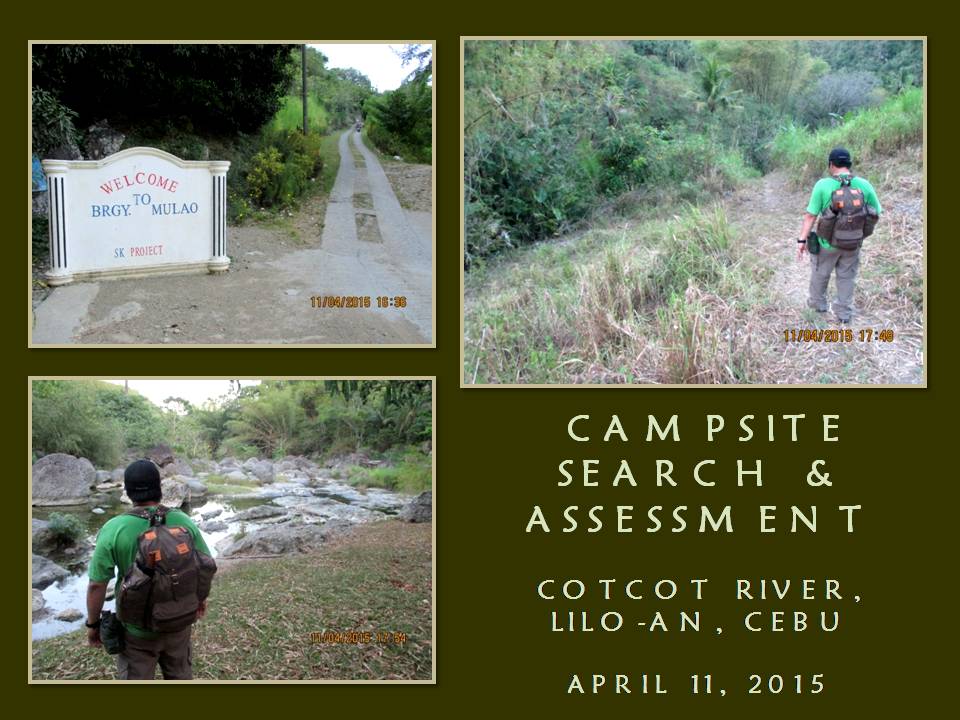
Today, April 11, 2015, I am going to Lilo-an. Coming along is Jhurds Neo, the President of Camp Red Bushcraft and Survival Guild. Automatically, he will sit in the PIBC as the Camp Ramrod – that is the camp administrator in layman’s term. We meet at Mandaue City at 14:00 and commuted in a public utility midget AKA the Multicab. Oh God, I hate that vehicle and I still patronize it. Oh dear!

Anyway, we arrive at 15:15 in Lilo-an and proceed on the business of procuring the food ingredients for our meals at the public market. Both me and Jhurds intend to stay overnight so we will cook and eat dinner tonight and breakfast for tomorrow. Once we have the items, we hired two motorcycles to bring us to the trailhead. I intend to start at the hanging bridge at the village of Mulao but my driver dropped me at the wrong place. Jhurds followed suit.

Upon inquiry with a local, we are a long ways off. We are at Cabadiangan and we will have to walk to a spillway from whence Mulao will start. If we walk fast, it would take us 90 minutes to reach the village hall of Mulao. We start on the road which begins to ascend once we got past the spillway. The road going to Mulao is adorned with garbage bins colored brightly and ornamental plants lining the sides.


We reach the village hall and register our names. We also get to pay a visitor’s fee of ten pesos each since the village had identified certain features of their place as tourist spots. The Cotcot River runs along the village and this same river is the boundary between Lilo-an and another town, Compostela. The river has huge granite rocks and water-polished boulders choking the river and two of these have names – Malingin and Arko’ng Bato.

We go down a path to Cotcot River and reach our old camping site where a lone acacia tree grow. I know there is no water source here but I heard that there is one near Arko’ng Bato and we will have to find it in the failing light. We reach the big boulder on a difficult route and it is already 18:00. It is almost darkness and shadows have claimed the banks where there are vegetation – the likely places where a natural spring would occur.

We are on a wide shelf of granite and we decide to set up camp there. We have water for cooking and drinking and we will use the stream for washing. Immediately, I forage dry driftwood which are plenty on the other side of the bank and that means I have to jump and balance over menacing rocks which would have been slippery and dangerous should it were wet. Warm days made it more acceptable to rubber though.


Once I got firewood, I return to the shelf and break the smaller ones by hand, the bigger ones with my AJF Gahum knife. Jhurds collect four stones of equal size and begins making a fire. I pull out my consortium of black pots and begins to slice 250 grams pork meat, peeled three potatoes, cut 20 green pepper, crush garlic and chop an onion with my Mora Companion knife. I enjoyed coffee first before I start to cook the pork adobao and boiled the potatoes. Jhurds, meanwhile, prepared the cooking of rice.

On an iron grille supported by the four stones, three pots are simultaneously placed over a fire, each having its contents cooked. We eat dinner at 20:00 under the clear starry sky with the frolic of the stream water supplying us music of nature. It is dark but we have small LED lights and a LuminAid solar-powered emergency inflatable lantern to light the place. The granite below us is still warm and this would help in our sleep later.

After that good meal, Jhurds wash the pots downstream. I stand guard with a light on him. It is so silent save for the swirling sounds of the river, the hum of crickets and the calls of geckos. Once in a while, a commercial plane would buzz overhead and pierce the harmony of the night with its engine. I see the familiar geometry in the sky that tell tales of mythical creatures and superhumans.

We enjoy the ambiance of the place so much that we spent the evening hours in conversations until it surprised us that it is already 23:00. We sleep on our respective hammocks which we use instead as ground sheet and bedding. The shelf is so wide that it removes away your fear of falling on the river while asleep. The smooth rock is warm which would be very helpful when the temperature would dip low during early dawn.


I wake up from time to time to check on our positions in relation to the river’s edge. We did not slide contrary to my fears. A last quarter moon crosses overhead and paints a silvery light on the riverscape. My brain react to the light with dread as if it is daylight. Everything is silent except the usual natural sounds. My fingertips are feeling the bite of the cold and I place hands on the part of my body where it is most warm.

I wake up when the first rays of light touched the highest mountains. I take a leak on the other bank and came back with an armful of firewood. My search for the natural spring is certainly not here and could be upstream. I do not know but it is best if I prepare our breakfast. I break two eggs and stir it briskly on a skillet after I sprinkled salt. I slice three eggplants into thin strips and drop all to the stirred eggs. I also peeled and sliced three potatoes.

Jhurds start the fire where the separate pots for the potatoes and rice are cooked. I place the skillet over the fire and begin frying the eggplant chips with oil. We eat our breakfast at 07:00 and then we start washing our pots. We notice a lot of dead river mudskippers and fresh-water shrimps. The shrimps turned red and I begin to suspect chemicals although I see traces of a poison plant pounded on a rock. I am confused since poison plants do not turn shrimps into red ones, a condition caused only by exposure to heat or strong medicine.


Cotcot River is sick and so polluted with chemicals and I see to it that my pots are thoroughly washed with strong detergents once I got home. The Municipality of Liloan should know about this so preventive measures would not kill the river in the future. I believe people fish for subsistence and wash their clothes here and exposure to chemicals would surely cause health problems for them.

We leave Arko’ng Bato at 08:30 going on a quest to find that natural spring. We meet a local fisherman carrying a sack. We inform him of the dead fishes and shrimps in the river and he showed me a good-sized catfish and a foot-long fresh-water eel. He found these already dead and would have brought these home as food when he noticed our great concern. He left the catfish and eel on a rock and I gave him our uncooked rice, eggplant and egg. Then we found the natural spring that we had been looking since yesterday.

It is surrounded by a spiny bamboo grove (Local name: kagingkingon), a Malabar almond tree (magtalisay) and an elephant apple tree (katmon). The spring gushed forth from the ground where a bamboo trough is placed. Nearby are several natural springs which were not used and the runoff caused a small marshy area. Across the spring is a river pond where bathing is possible and downstream small waterfalls and jacuzzi-like channels.

Satisfied with our find, I taste the water and I notice it has its own distinct taste. Could be from granite. Anyway, a good water source gives the possibility of hosting more people for the PIBC, which I feared would come. We walk on upstream and begin the next phase of finding a good campsite which could accommodate many light shelters, tents or hammocks. We found a good spot where there are several mango trees and a few groves of spiny bamboos in the vicinity.


The spot looks familiar. This is the same place where Aljew Frasco had taught Notching on the rest of Camp Red last March 9, 2014 (CB 11: A Notching class by the Riverside). Then the old hanging bridge linking Mulao of Liloan to the Mulao of Compostela would not be far. The same bridge that we were supposed to get dropped yesterday were it not for my driver’s judgment error. I am bestowed with good fortune today and I am happy that my expectations had turned out right the way it should be.

I know the route now to the hanging bridge but we take a shortcut instead to farms and over a low hill to get there instead of following the river. We reach the bridge at 10:20 and both of us deserve rest and a bottle of cold soda drinks each. After that, we begin another uphill walk on a road which has no trees to shade us. It is concrete and it took us over an hour of walking to reach a road corner where another road goes down to the same road where walked yesterday.

Then the “cavalry” arrived in the form of a red Toyota 2003 pickup driven by Christopher Maru and we were “rescued”. Christopher is Camp Red and had participated the PIBC in 2013 together with Aljew. We reach the town center of Lilo-an before noon and take lunch at open eateries near the municipal hall. Then I make it sure that we will not commute by riding in a public utility midget AKA the Multicab. Our mission is accomplished.


Document done in LibreOffice 3.3 Writer