Showing posts with label guiding services. Show all posts
Monday, November 21, 2016
NAPO TO BABAG TALES CXIII: Hard Reality
THE
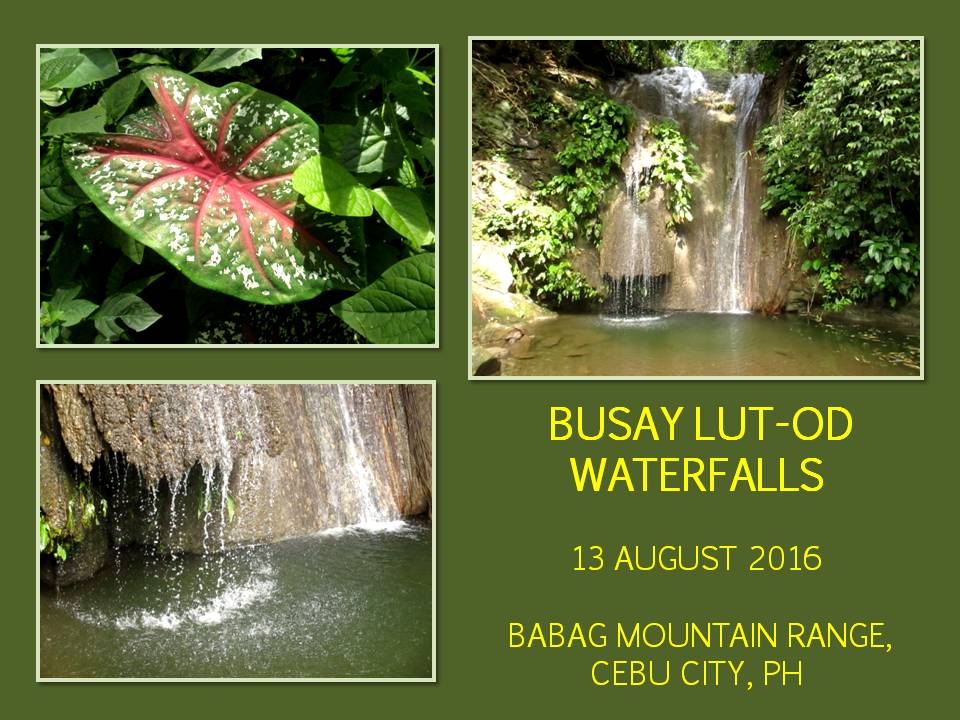
BUSAY LUT-OD WATERFALLS of Sapangdaku, Cebu City is not a tourism
destination compared to the more spectacular and popular ones like
the Kawasan in Badian, the Tumalog in Oslob, the Mantayupan in
Barili, the Aguinid in Samboan and a host of others which dot the
island of Cebu. But I am happy about its anonymity. It meant that
it will not host people.
Locals
have told me long ago that the Sapangdaku Creek pass through five
succeeding drops – like a giant staircase – hence, the name
“busay lut-od”. In all my visits there, I have come to
know, and seen, of only three. Maybe because of a single path to one
which lets me see the two other waterfalls, all at the same time. If
I have time, I might visit the rest of the Busay Lut-od.
I
have guided many people here in the past years, to include fourteen
Danish girls, but I am now a bit choosy. Sometimes I refer it to
other people like the time a celebrated Old Manila tourist guide,
Carlos Celdran, visited and bathed here in 2014. Sometimes I just
leave requests unanswered when I find myself busy with other projects
or that would-be clients are a bit stiff for my comfort.
I
do not personally guide people there anymore if you are just after
scenic landscapes, for leisure’s sake or in the aid of your
physical exercise. I would, if you could tickle my interest like
what would I gain if I do so? I am more of a wilderness guide and
less of a mountain guide and that might cost you more. But, do not
worry, I have associates to fill your wanderlust.
I
have brought people there again just this year. The outdoors is now
my full-time occupation. Last March, students from the Cebu Normal
University conducted an interview of me in the pursuit of their
studies. In July, I accommodated Australian guests to a city
wilderness tour which brought them here to the Busay Lut-od. Today –
August 13, 2016 – three students from the University of San
Jose-Recoletos will have their chance.
I
am almost always very welcoming to students doing field study, not
necessarily in the wilderness, in the pursuit of complying their
school requirements. I am a parent myself and I know the stress one
gets when their kids do not make the grade through difficult
circumstances. I am very accommodating here and I gave them guidance
and hints on anything they need to know.
It
is a warm morning, almost perfect, with wisps of clouds floating by.
We all meet at the parking lot of the Our Lady of Guadalupe and, at
first, there were four: two males and two females. They are BS
Tourism students and they will make a feasibility study of the Busay
Lut-od Waterfalls. I gave them the idea of the terrain, climate,
prominent landmarks and other things of what to expect along the
trail.
Most
of the time some students do not understand how the outdoors looked
like or how they would fit themselves in there. The choice of
clothes and footwear are disappointing. They, almost always, dress
for the malls. Well, I could not help it except manage my pace to a
creeping one with lots of rests. I hope the Guy Upstairs would turn
back the temperature by a few degrees.
To
distract the tightness and difficulties of what they wore, I talk
about the plants growing along the trail and beside the stream. I
point to them a durian tree with several fruits hanging at its high
branches. The same with a marang tree. Only one from the four could
discern the rarity of durians in Cebu. At another time, a farm of
roses and daisies. Then broccoli-like canopies of mango trees in the
distant hills.
The
long rests under the shade of trees begets me smiles and their
gratitude. If they could only talk about their feelings.
Nevertheless, I would know what they are feeling right now. That
their tight shoes and tight jeans beget blisters anytime today. It
is a given. The outdoors is not something to take for granted. They
should do their homework.
We
reach the river crossing where there is a natural spring. I insist
that they rest long here as the path will be slightly steep once we
proceed to the waterfalls area. As they talk among themselves, I
refilled my Nalgene bottle. Their leader, Peter Lubas, is much more
prepared than the rest and he is carrying a heavy camera with heavy
accessories.
He
says, he chanced upon my name when he read the blog, Adrenaline
Romance. Besides that, the owner of the blog, Gian Carlo Jubela, who
is a friend of mine, recommended me for this sort of project. He
emailed me but I suggested to him to search me in Facebook instead,
which he did. I gave him my discounted professional fee which he
accepted to fulfill once they have sufficient material to document.
That
material for documentation is still a long way but their efforts
would not go to waste. On the moderately steep trail, they walk with
so much labor. I assure them that it is just 30 minutes to condition
their mind so they could time their attempts. On the last rise, we
arrive at another path going down to the waterfalls. It is steep
with loose surface the last time around.
I
go down first and then Peter and the two girls. I believe the other
guy is covering the tailend of our downhill hike. I took a headcount
once I reached the first waterfall. Three. The last would still be
up there, I guess. I would give him two minutes. It was that moment
after I gave a briefing to the three that I noticed the other one had
not arrived yet.
I
left the three and made my way up and see no one there. He might
have turned back. The tight jeans and tight shoes might have to do
with that. Painful lessons. I go back to the three and informed
them of their missing companion. They smiled but they already know
the reason why. I gave them space. I climb the side of the
waterfall and I am now on another level. Another waterfall,
The
two girls took a bath while Peter climbed up to photograph this
second waterfall. For an hour, they take their fill of this hidden
wonder, just a few kilometers from Capitol and not much walking and
fare expenses. It is just at the backyard of Cebu City. Quite
accessible but, let the rest know about it, and it would be heaped
with garbage, just like all those popular waterfalls I just named.
The
activity ended before noon and we were already at Guadalupe. I
earned my guiding fee and it is a hard way to earn one when you know
that what was sideline then becomes now your bread and butter. It is
not everyday I get chances like this. It is a hard reality. Despite
that, I choose to be choosy.
Why?
Because I refuse to earn without conscience. I am against
commercialism and popular tourism. I am one of the last gatekeepers
of our Mother Earth.
Document
done in LibreOffice 5.2 Writer
Posted by
PinoyApache
at
11:00
0
comments
Labels: Busay Lut-od Waterfalls, Cebu City, guiding services
Sunday, September 18, 2016
BUSHCRAFT BUHISAN XXXVIII: In the Big League
TEACHING
BUSHCRAFT AND SURVIVAL is a passion which I love to do. I found
pleasure in sharing it to my fellow countrymen and to foreigners
alike. Language barriers are not a problem with me and I find it
entertaining to see faces of people amused at my thick Cebuano-laced
tongue trying to make a conversation in Tagalog or navigating my
lecture through its intended course in my coarse English,
supplemented with hand gestures to cross the language barrier.
It
is good that I have something to read on in almost-perfect English
prepared by me, of course, which is now standard matrix to which I
conduct these outdoor trainings. In the entire album of my photos,
you might see me reading to the participants or discussing something
to them while holding stapled sheaves of bond paper. I do not teach
in helter-skelter fashion and I do these, instead, in an organized
manner.
It
is not often I receive foreign guests interested to learn the BASIC
TROPICAL BUSHCRAFT COURSE like I did once coming from the UK and the
USA. While English may be the preferred international language in
business and commerce but it is still Greek to a lot of people
specially from the former Eastern bloc countries. I even toyed with
the idea of learning basic Russian, if ever these guys come to town.
They did come, however.
What
came to town instead were five guests from Poland. Surprisingly,
they can speak and understand English very well and it made my day.
That day is January 13, 2016 and I arrive at their hotel early in the
morning to pick them up and whisk them away to the parking lot of
Guadalupe church. Another client – a Filipino – arrive to take
his place inside the small Suzuki Scrum mini pickup that I hired
while I wait for my assistant.
After
finishing with my procurement of food ingredients, Ernie Salomon
arrive and take his place in the ever tightening room of the small
Suzuki. We proceed to Baksan Hills while the driver shift to
four-wheel drive as the road go steep. We arrive at the trailhead at
around 08:00 and I do my first duty by briefing all my guests of the
terrain and the camp rules. I intend to set up our campsite at the
old Camp Damazo.
While
I have taught outdoor seminars of this same nature many times in the
past, I did it part-time since I have a day job. After I have parted
with my employer on the last day of 2015, I decide to go full time.
This would be my first endeavor as an unemployed. The five from
Poland and one Filipino would be my first clients. I am providing
them a Silangan Rev 20 tent and three hammocks (Silangan and
Tingguian Tribe) for this occasion plus an Apexus fly sheet. Sef
Abella, the lone Filipino, has with him a hammock-and-shelter set.
I
am left with a cheap laminated-nylon sheet which I intend to use as a
ground sheet to sleep upon without an overhead shelter and hope that
it never rains. Ernie will not stay overnight but will prepare the
meals when I start the lectures. I tied up the hammocks and the fly
sheet between four trunks while two Poles set up the tent. The camp
ground is dry while Creek Alpha below still has running water which
vanish and appear in some places.
Our
water supply are composed of bottled water and in Nalgene bottles. I
may have to supplement these by sourcing water from the streambed for
cooking and washing since what we have are not enough for two days.
The jungle is a humid place and it is very warm, especially after a
light shower had fallen down. We dug two water holes on the sandy
bed and line the insides with stones and let the silt settle down.
Meanwhile, I designate the latrine area sixty meters away from our
camp.
When
I have taken coffee, I begin by introducing myself to the
participants, then the Introduction to Bushcraft. Bushcraft is very
popular in the northern hemisphere, especially among countries
located in temperate zones – which Poland is – and this is a
serious activity for them. While bushcraft may be associated or
mixed in with survival, I emphasized that bushcraft is really
different from survival. While survival is immediate, bushcraft is
the preparation thereof.
As
they begin to understand that, I proceed to Ethical Bushcraft. When
a lot of people begin to practice bushcraft as a leisure weekend
activity, expect land owners and park managers to frown upon them,
like those happening in the USA and the UK right now. Here in the
Philippines, people have not totally grasped the idea of bushcraft
yet, but, in time, they will. My introduction of Ethical Bushcraft
in all my outdoor seminars is to educate people about the judicious
use of forest resources.
Among
the most important tools in bushcraft and, to a higher extent,
survival, is the knife. Since it cuts through organic material and
flesh, education about its proper use is of high importance. The
topic of Knife Care and Safety precedes everything before handling a
knife or any type of blade. This covers from safety carriage and
rest, travelling, blade-handling efficiency, blade designs and
grinds, sharpening techniques, courtesy, the Nessmuk trio, even our
local knife law, if it helps them.
I
would have Survival Tool-Making as the next topic like I did with my
previous seminars but I proceed instead to Plant ID and Foraging.
This section talks about hunting for food, collecting essential items
like tinder, foraging edible plants, making traps and snares, and
identifying plants, especially the toxic kind, which the tropics has
a lot. Here in the Philippines, edible plants are that many since
most of these are introduced from Central and South America by the
Spanish and, later, by the Americans.
I
will have to engage them in a Discovery Hike so they will encounter
some harmful plants like the rattan vines, the stinging nettles and
the Asiatic bitter yams on our way to forage a bamboo pole which can
only be found at Creek Bravo. The bamboo is essential in tool-making
and can be carved easily with a knife according to its use. I found
no dried bamboo of the exact size for fire-making and have to make do
with a smaller one. It is a thin and flimsy piece.
When
I have secured a green bamboo pole and the dry bamboo, we double back
to camp for our lunch, since it is almost 13:00 already. Ernie did a
good job of the pork adobao and the five Poles found it excellent.
We always cook our food without monosodium glutamate (MSG) and their
derivatives disguised as “magic mix”. I have influenced Ernie
how to cook with the right frame of the mind and, for that, he is now
the best outdoors chef in Cebu, even in the entire country, hands
down!
After
an hour of siesta, we begin Survival Tool-Making. It is about making
survival tools for just about anything from digging sticks, cordage,
dining and cooking implements, hunting and fishing applications, and
others as obscure as the batoning stick. I show to them the idea of
a digging stick – taller than me, heavier than usual and flat-edged
instead of pointed. Then we proceed with cordage using fibers of
plantain. Making it strong by twining three lengths and braiding
these together.
To
apply what they learned in knife safety on the making of survival
tools and to practice their dexterity with a knife, I suggest to them
to make spoons and drinking jugs from the green bamboo pole. Before
they start that, I teach them how to use a small knife to cut up
bamboo with the use of a baton and how to make a cooking vessel from
the same bamboo using the Trailhawk System. I choose my William
Rodgers knife to do that demo.
While
all are busy, I make a pressure-trigger snare from small pieces of
bamboo. It may look so complex but, actually, is the most common
type that most people use. When I find them in a lull, I lead them
to where the snare is located and show them how it works. You may or
may not place bait and it works better with heavier fowls like
chicken, ducks, turkey and geese. Meanwhile, Ernie has to leave at
15:00 but he marinated the rest of the meat for our supper later.
Time
ran its course and, when we sensed that it is already 16:30, we
forage more firewood. Sef ably helped me with the fires and the pork
barbecue. The Poles are now ready to cook rice on their bamboo pot.
I teach them the Trailhawk System for cooking rice which is quite
different with how you usually cook it. Dinner came at 19:00 and the
rice was perfectly cooked. The bottom of the bamboo did not suffer
holes and I am quite satisfied of their job.
The
Campfire Yarns and Storytelling begins with knowing each country.
The Poles are curious about our close attachment to the Americans and
what would I feel about the idea of different price tags for tourists
and another for locals? Our fond regard of the USA started when it
introduced public education which a former colonizer failed; then we
fought with them in Bataan and suffered the same ignominy after
defeat. Many of their soldiers voluntarily stayed to resist tyranny.
We fought with them again in Korea and in Vietnam even though these
were not our war.
My
guests have visited Loay, Bohol and Oslob, Cebu and they would
proceed to El Nido, Palawan tomorrow. They do not like places which
are saturated with tourists and that is why they took a chance with
learning bushcraft in a jungle. Double pricing is giving tourism a
bad name and I do not like this practice. In fact, a lot of
Filipinos do not like it at all and the government should take steps
to regulate establishments employing this bad practice. In fact,
what price I gave them are similar to what I offer to Filipinos.
Now
my turn. I asked them if they know Lech Waleska and St. Karol
Wojtyla? All five knows the former but only one knows the latter. I
have seen Karol Wojtyla when he came here in 1981 and he was carrying
the more popular name of Pope John Paul II. I mentioned the places
Pomerania and Gdansk and they describe to me of these places. When
they will return to Poland, it would be the start of winter and they
would expect below zero temperatures.
I
carried a metal flask filled with a specially aged Matador brandy and
I shared this to my guest which made our conversations more fluid.
All turn in at 21:00 while I stay awake to stand guard and watch over
the fire. I am sleeping out but I am protected by a hooded wool
sweater. Fortunately, it did not rain. I enjoyed the MP3 music from
Cherry Mobile U2 phone tuned low. I believe drowsiness won over me
at around 02:00.
I
wake up the next day – January 14 – at 05:30 and everybody are
still asleep. I use a Trangia alcohol burner to boil water for
coffee. After I had coffee I cook an egg omelet with that and slice
it equally for 11 sandwiches – two each for the five from Poland,
one for Sef and none for me. Also fry 20 pieces of small “lumpia”,
grounded meat handrolled with thin flour wrappers.
Breakfast
was decimated without a waste and they begin to pack their things and
clean up the campsite. They have a plane to catch at 14:00 and I
promised to send them off to the airport before 12:00. One guy
showed me an unhusked coconut that he found at Bohol and asked me how
to open it. I showed him how and I prepared a small cook pot
underneath to catch the liquid when the shell is broke. All five of
them took turns in sipping the coconut water.
But
I have one last topic to talk, which is Firecraft and it is already
09:00. I have to make this quick. Would that be possible? I have
to improvise and start off with what makes a fire. I talk about the
fire triangle where three elements should be present so fire could
start and, conversely, you take away any element from the three and
the fire dies. There has been a revision with this and they added
another element – chemical reaction – to make it a fire
tetrahedron. But I liked to explain it in its old context because it
is simpler.
Then
I reminded them that the firewood they collected yesterday from the
ground were not the best firewood because these absorb moisture from
the ground and it hampers the progress of your fire. The best
firewood are those that are found hanging or those that do not touch
the ground and it is best that you start with pencil-lead sizes, then
pencil-wood sizes and, lastly, the thumb sized.
Tinder
materials are anything that is light, dry and fluffy. I prepare a
tinder bundle, sometimes called a “bird's nest”, and show them
how it is done. On the contrary, it is best that you collect
different tinder material and store these in a fire kit else you make
one yourself. I show them my fire kit and the different tinder I
foraged as well as charclothe inside the can that had been used to
make these. I show them the original material – pieces of cotton
jeans – before these were charred and turned into charcoal clothe.
I
start making fire with the easiest which is now very popular because
of the advent of survival TV, and that is striking a ferro rod.
Taught them two different styles in striking a ferro rod which both
participants tried with success on my tinder made from a hair-like
fiber of a sugar palm. Showed them also a much older contraption –
the flint and steel – which should be paired with charclothe.
Then
I proceed to the friction method of making a fire. I have already
prepared the one with the flimsy bamboo yesterday. I show them each
piece of the bamboo fire-saw and what should you do with it,
including its tinder bundle, which I demonstrate in making one. I
rub both pieces and it emit smoke until the bottom piece broke caused
by the pressure of my weight and the process of rubbing. On the other
hand, I find no success with the bowdrill method as the pressure of
time is now so greatly felt. I remembered their flight schedule.
I
decide to pack my things inside my two bags I used for this occasion:
a Sandugo Khumbu 40L and a Lifeguard USA. We retrace the trail that
we took yesterday in coming here. We arrive at the road at 10:50 and
walk for about a kilometer downhill where the Suzuki Scrum is
waiting. We arrive at the departure area of the Mactan-Cebu
International Airport at around 12:10 despite encountering traffic
caused by the festivities of the coming Sinulog Festival.
We
parted and I believed I have entered the portals of the big league
reserved only for those who have created their name doing what they
loved best. I cannot turn back now and I am made.
Document
done in LibreOffice 4.4 Writer
Posted by
PinoyApache
at
08:30
0
comments
Labels: Buhisan Watershed, Cebu City, guiding services, training
Friday, May 6, 2016
NAPO TO BABAG TALES 100: Wet and Wild
AFTER
MY YESTERDAY'S boo-boo, I finally got over it and go, once again, to
the parking lot of the Our Lady of Guadalupe Parish. Today, August
23, 2015, is real, for sure. The biology class of the University of
San Jose-Recoletos are coming over. According to their professor,
Ryan Ymbong, there will be twenty of them.
Unfortunately,
Ernie Salomon will not be with me. Another from the Camp Red
Bushcraft and Survival Guild – Nelson Tan – will take his place
but he will be late. Fine. For the past few days, weather patterns
are beginning to be predictable. Rain will pour hard during noon and
another sequel in the middle of the afternoon. Well, I am ready for
that but I am worried about my guests.
I
waited. Killed time by listening to the MP3 feature of my Cherry
Mobile U2 phone. A white passenger van arrived and out comes Prof.
Ryan, I presume, from the front seat. He instantly recognized my
khaki Silangan Predator Z backpack prominently placed on the concrete
pavement. My worries stretched into a frown as most of the students
are not wearing proper footwear.
That
would really be a problem when the ground turns muddy but, as long as
it does not rain this morning, that difficulty will not be much of a
problem. Anyway, I join the professor on the front seat and the
driver took us to the community of Napo. As we arrive, I immediately
gather them all and gave them a short briefing of the terrain and the
rough estimate of the distance to our destination.
Noticing
that some were carrying heavy things inside big plastic bags, I
requested these be equally distributed to others. I myself volunteer
to carry the heavy bunch of rice cooked in coconut-leaves (Local
name: puso) and the breakable items. At least, for now, the
load carried by hand would be tolerable and there would be no danger
of the plastic bags getting torn by blades of grass. Sturdy plastic
bags, I noticed, are beginning to disappear, replaced by those
brittle biodegradable ones.
We
start our activity with a prayer by Prof. Ryan. I lead but I walked
like someone who is strolling in Plaza Independencia under a pale
light of a full moon. Yeah, that slow. I believe (and I know) that
some pairs of feet would get skin blisters soon considering that I
saw bare skin above shoes indicating no socks at all. Oh well, what
a great way to learn plants and of hiking – later. That is why I
walk slow. I see a stinging nettle (daw-daw) and I begin my
own version of Plant 101.
I
am interested to learn more about plants since I teach people about
bushcraft. I have only a limited data of it right in my head learned
from the nuances of growing up, from books, from the mil and from my
late grandpa, who left me alone time and time again in a forest,
usually at dusk or at dawn, during his tireless journeys, mostly in
Bohol, while I was five and seven. I learned so many things from him
and what I learned I share.
I
may know some plants but it is limited to the local names, the
features and its uses. I do not have time for its scientific names
but, later on, through self-study, I begun to know its English
equivalent and, to a much difficult degree, their Latin conundrum.
Those that I have discovered recently, I turn to professional advice
in the Web but, mostly, site administrators are as stupid as I am and
so unaccommodating, leaving you more ignorant.
However,
perhaps, I may learn a thing or two from this bunch. Prof. Ryan had
read my blog and had requested me to guide them to a good site at the
Babag Mountain Range. I know places there where vegetation are thick
and would be a hoard of treasure to a biology student. It is where
streams pass and you do not need people to wreck havoc on their
bodies by leading them to difficult terrain.
When
you are into the business of wilderness guiding, improvisation
matters. It is different to mountain guiding where elevation,
adrenaline and scenery afforded by peaks are its main pursuits. I
had been guiding people for some time and I find the latter too
dangerous and too boring for my age. In the former, I found
fulfillment. It is that which people tend to appreciate your skills,
your knowledge and your time.
The
path is wet and parts of it are muddy which is bad enough. It will
get worse when rain comes falling. I change paths and follow the
trail going to Sapangdaku Creek. We follow it upstream until we are
on a level ground above the stream. This place is called Kangsi by
the locals and a lone family lived nearby. This would be a perfect
place as it had been previously in several activities that I
organized.
Prof.
Ryan began instructing his students, which are composed of the purely
BS Biology discipline and those of BS Education with major in Biology
Studies. They had with them their instruments in aid of their field
study like a GPS, thermometers, ropes, iron pegs, Petri dishes, glass
jars, cameras, pencils and journals. They are divided into four
groups.
The
area is divided into four quadrants and lengths of rope are unrolled
to delineate each quadrant from the other. I assisted each of the
four groups establish their own quadrants, especially the ones that
has the ropes go over the thickest vegetation. My big AJF Gahum
knife did a lot of work to clear a way for me to bring one end of a
rope to its farthest reach.
Three
of the quadrants cross streams while one covered steep ground. The
groups then collect their specimen, which are then documented after
several guessings of its taxonomic category, including the GPS
coordinates where each is found. Aside from plants, they also
gathered three kinds of grasshoppers, some crickets, a mosquito,
different butterflies and two varieties of fresh-water guppy.
The
rain came as expected, near noon, and all collecting activities stop
to concentrate instead to the preparation of their pre-cooked meals.
It is not safe to work on the streams for fear of flash floods.
Instead, I produce three banana leaves to cover the ground where the
food will be placed. The rice in the “puso” are many and
I could not believe I carried it all. Viands are the Tisa “siomai”
(Chinese meat rolls), “pancit guisado” (local noodles),
pieces of fried chicken and canned goods.
We
eat our lunch under the onslaught of rain. Fortunately, Nelson
arrived just in time to set up a tarpaulin sheet over where the food
is laid. To those who cannot be accommodated below the shelter, to
each his (or her) own to find some semblance of cover to justify a
human necessity of providing nutrition to self, like me. I have been
into this situation many times and it does not matter with today's
inconvenience.
There
is a lull in the sky and we were even afforded a glimpse of sunlight
yet I expect rain to come back with a vengeance later. The specimen
collection continues at 13:30 and everyone proceed to their assigned
quadrants. The stream had risen a bit and the current brisk.
Everyone pursue their work with wet clothes while I and Nelson stand
guard. I keep a special attention on the stream and on a shooting
suspect on the loose named Timoteo Gabasan.
By
14:15, the rains come back earlier than expected but it had stopped
after about thirty minutes. The students ignored the inconvenience
and concentrated on their field studies. At 15:30, the rains struck
once more, and again, at 16:15. When Prof. Ryan sees that his wards
have had enough of specimen collected, he called a cession to their
activity and everyone obliged and repacked all their equipment and
other things.
We
leave Kangsi (it rhymes like Camp Xi) at 16:30 under the cover of
incessant rain. The going was tough for those who wore rubber
flip-flops, ladies' sandals, espadrilles and all sort of improper
footwear, which almost were. They have to negotiate a slightly steep
path from river bank to the main trail which looked like a crude
imitation of a water slide and the main trail itself has pools of
water along some stretches where there are depressions.
Prof.
Ryan was exhausted after the hike back to Napo and he was the last
one to arrive. Their transport have arrived earlier and waited until
such time that everyone were accounted for. I take my usual place on
the passenger van where I got dropped off at Guadalupe. Nelson,
meanwhile, took his motorcycle and was already gone when I arrived.
I would part Nelson his share of the fee when we meet next time.
Anyway,
I accept people who requests of my services in guiding them to the
mountains but, mostly, I refer it to my subalterns if it is for
leisure hikes only. I would personally engage if the purpose is of a
higher calling like today. I used to be a freelance mountain guide
many years ago and I find no satisfaction in that because it demands
technical skills and the risks are great with which compensation does
not tally well with your efforts and the gears you invested.
As
a wilderness guide, the risks are not that great and does not demand
expensive gears. You have to have a different set of skills quite
different from those activities done at higher elevations and is much
in demand and, therefore, a bit expensive than usual. Guiding an
archeological or a scientific expedition is one such example where
the professional wilderness guide should be extraordinary and possess
a high-level of expertise and ability.
Whenever
you have such need of a guide for a planned Philippine expedition
project, I can be contacted and be hired directly through my mobile
numbers at +639172035101 and +639333225005 or you may email me at
pinoyapache (at) yahoo (dot) com. If you so desire to see my
credentials, I can attach it in my email in PDF or JPEG, whichever
you prefer.
Document
done in LibreOffice 4.3 Writer
Posted by
PinoyApache
at
09:00
0
comments
Labels: guiding services, plant ID, Sapangdaku Creek
Saturday, July 23, 2011
NAPO TO BABAG TALES XLII: Leading the Danes
CAMP RED, FOR A change, went on a guided eco-tour of fourteen social educators from Denmark on February 5, 2011 at the foothills of the Babag Mountain Range, Cebu City. There were fourteen of them; I am the pointman; Boy Toledo as lead man and Ernie Salomon bringing up the tail. Wil Rhys-Davies of BushcraftAsia.com lights up the party in the middle with anecdotes and short tales.
Along the way, I introduced the visitors to the different tropical trees and plants, its names and its uses. They were shocked to see very dense vegetation in such small country like Barangay Sapangdaku which they found lacking in their home country. They were very elated crossing rivers and game enough to tackle steep trails.
They bathed under a hidden waterfalls of Busay Lut-od; drank the natural spring in Lower Kahugan and, later, slurped on the green coconuts at the Roble homestead. They enjoyed so much the sights of flower farms; awed at the strange structures of our native houses made of bamboo and wood; and got introduced to Filipino cooking. They even used the native outhouse of the Robles.
In between, I inserted bushcraft cooking and they were amazed at the simple bamboo being used as a pot to cook milled corn. The skies cooperated and give out a very perfect weather even as Father Sun refused to show his face. Below are the sets of collage showing the activity in its most vivid moments. Enjoy!
Document done in OpenOffice 2.1 Writer
JPEG-generated images from MS Powerpoint 2003
Posted by
PinoyApache
at
20:34
0
comments
Labels: Cebu City, eco-tour, guiding services
Subscribe to:
Posts (Atom)